You need to enable JavaScript to run this app.
RDS for PostgreSQL

RDS for PostgreSQL

Copy page
Download PDF
Extensions
Bitmap computing (pg_roaringbitmap)
Copy page
Download PDF
Bitmap computing (pg_roaringbitmap)
The pg_roaringbitmap extension is an efficient bitmap storage and computing extension.​
Implementation principle​
The RoaringBitmap algorithm mainly addresses the fixed space consumption issue of traditional Bitmap. It reduces Bitmap space usage while providing high-performance bitmap computing. In the most extreme scenarios, traditional bitmap may occupy a large space even when storing only two numbers. For example, storing the numbers 0 and 1,000,000 requires traditional bitmap to pre-allocate 1,000,001 bits, about 125 KB of space; but Roaringbitmap only requires 8 bytes in this case.​
Classic RoaringBitmap algorithm​
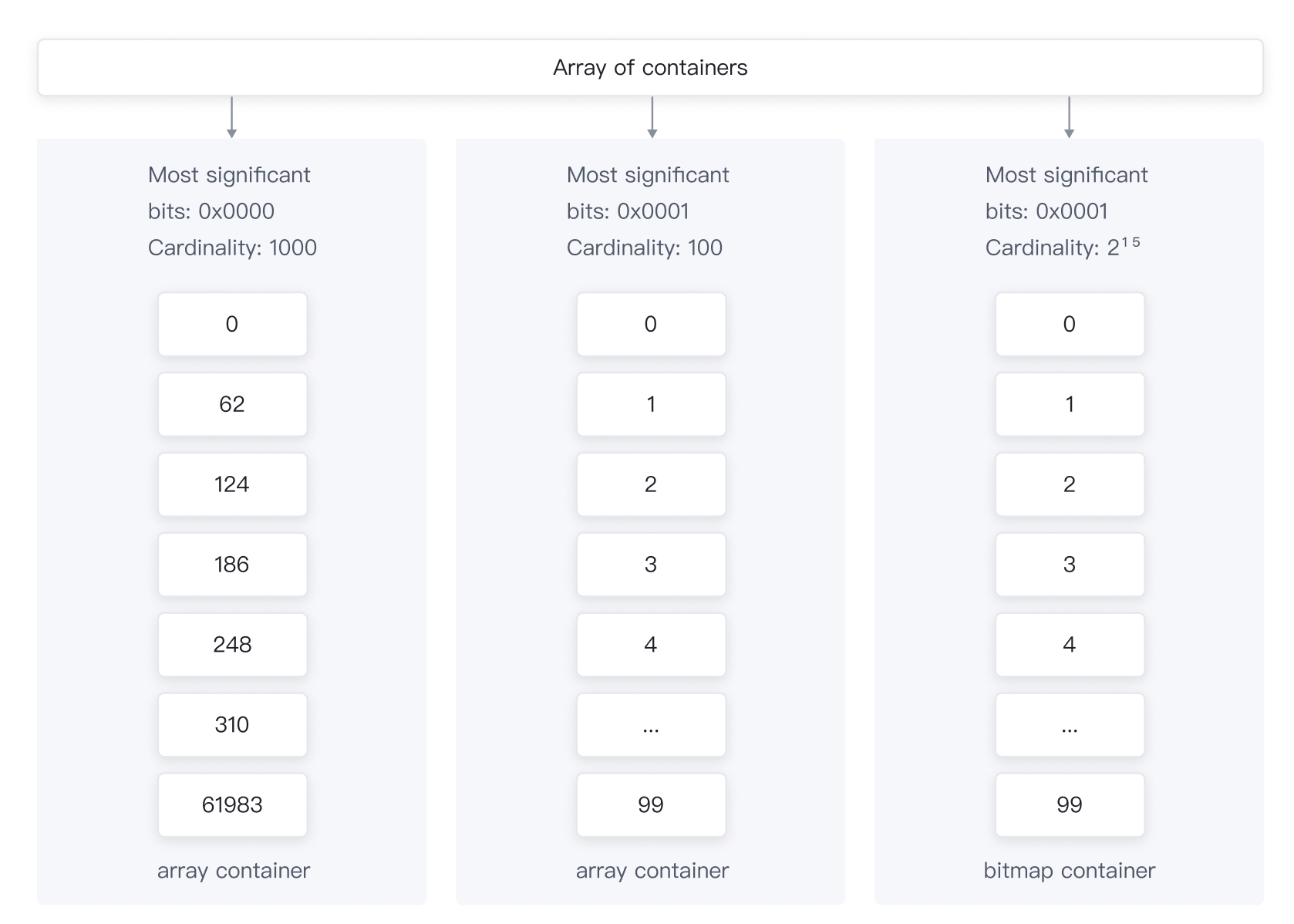
The classic RoaringBitmap algorithm divides each 32-bit signed integer in the set [-2147483648, 2147483647] into two parts: high 16 bits + low 16 bits. The high 16 bits serve as the first-level index for storage and retrieval, while the low 16 bits are the secondary data stored in Containers. Containers have two Types: Array Container and Bitmap Container, as shown below:​
​alt​​
In the above Roaring bitmap, the 4-byte integer values stored have high 16Bits of 0x0000, 0x0001, 0x0002 respectively:​
  • High 16 bits 0x0000: stored using an ordered Array Container, containing the first 1000 multiples of 62.​
  • High 16 bits 0x0001: stored using an ordered Array Container, containing 100 integers in the range [216, 216+100).​
  • High 16 bits 0x0002: stored using a Bitmap Container, containing 215 even numbers in the range [216, 3×216).​
The choice between Array Container and Bitmap Container depends on the number of 16Bit integers stored in the corresponding Container. The details are as follows:​
  • When the number of 16Bit integers stored in the Container is less than or equal to 4096, the maximum space occupied by a single Container is 4096 * 16Bit = 8KB, and an array container is used for storage;​
  • When the number of 16Bit integers stored in the Container is greater than 4096, a Bitmap container is used for storage. The space occupied by a single Bitmap container is fixed at: 216Bit = 8KB.​
RoaringBitmap used by the extension​
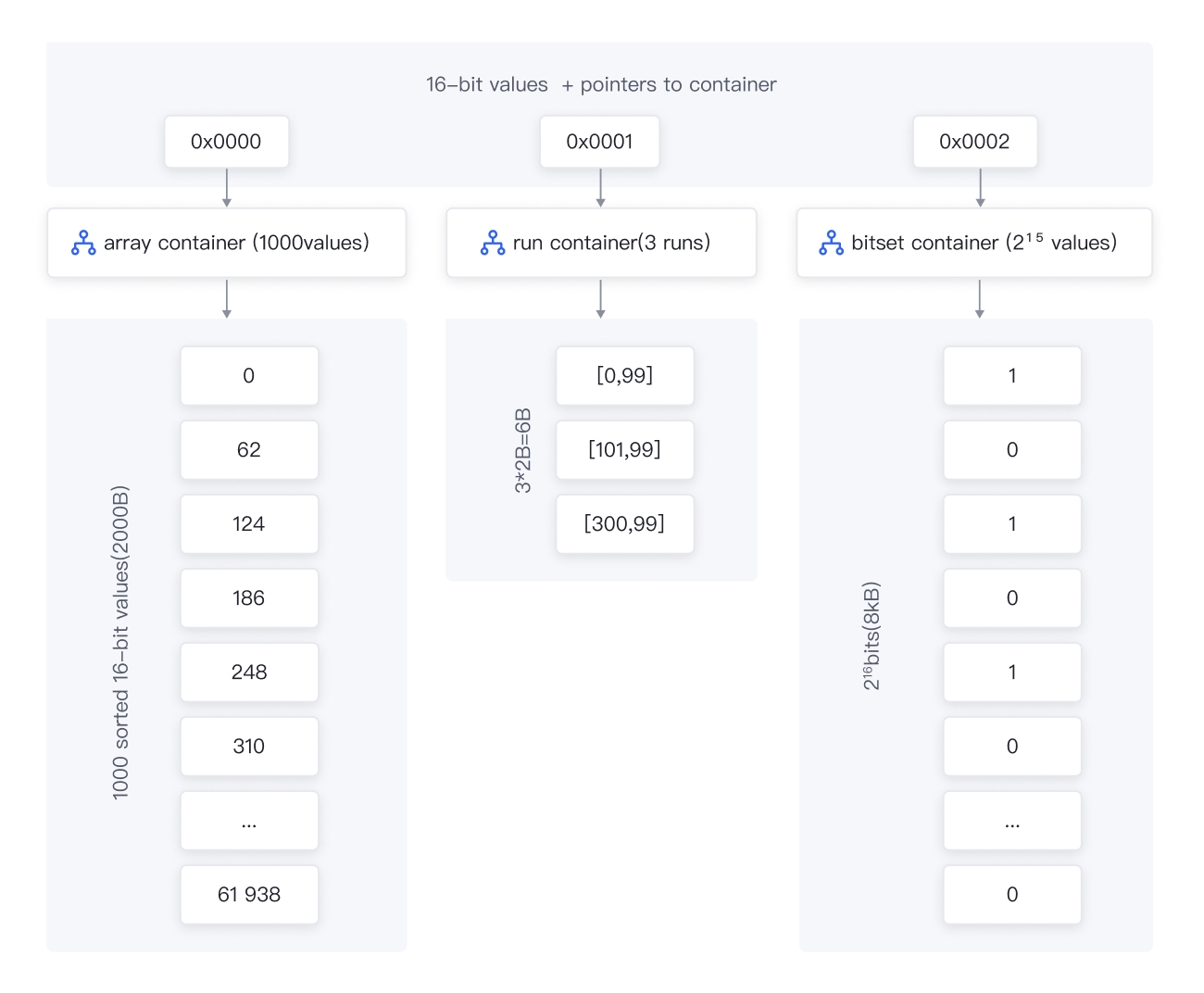
The RoaringBitmap used by the Extension adopts an algorithm that adds run container optimization to the classic RoaringBitmap algorithm, optimizing bitmaps with step properties. The details are as follows:​
​alt​​
In the above Roaring bitmap, the 4-byte integer values stored have high 16Bits of 0x0000, 0x0001, 0x0002 respectively:​
  • High 16Bit 0x0000: stored in an array container ordered array, storing the first 1000 integers that are multiples of 62​
  • High 16Bit 0x0001: stored in a run container in compressed form, storing three intervals [216, 216 + 100), [216 + 101, 216 + 201), [216 + 300, 216 + 400) totaling 300 integers, with the container occupying only 6Bit.​
  • High 16Bit 0x0002: stored in a bitmap container, storing 215 even numbers in the range [2×216, 3×216).​
Install extension​
Use the following command to install the extension.​
tip​
A super account is required to create the extension.​
​
create extension roaringbitmap;​
​
​
tip​
A super account is required to create the extension. Instructions​
Data type​
​
Type name​
roaringbitmap​
Usage example​
​
select '{}'::roaringbitmap;​
select ' { } '::roaringbitmap;​
select '{ 1 }'::roaringbitmap;​
select '{-1,2,555555,-4}'::roaringbitmap;​
select '{ -1 , 2 , 555555 , -4 }'::roaringbitmap;​
select '{ 1 , -2 , 555555 , -4 }'::roaringbitmap;​
select '{ 1 , -2 , 555555 , -4 ,2147483647,-2147483648}'::roaringbitmap;​
select roaringbitmap('{ 1 , -2 , 555555 , -4 }');​
select '{1,2,3,4,5,6,7,8,9,10,11,12,13,14,15,16,17,18,19,20,21,22,23,24,25,26,27,28,29,30,31,32,33,34,35,36,37,38,39,40,41,42,43,44,45,46,47,48,49,50,51,52,53,54,55,56,57,58,59,60,61,62,63,64,65,66,67,68,69,70,71,72,73,74,75,76,77,78,79,80,81,82,83,84,85,86,87,88,89,90,91,92,93,94,95,96,97,98,99,100,101,102,103,104,105,106,107,108,109,110,111,112,113,114,115,116,117,118,119,120,121,122,123,124,125,126,127,128,129,130,131,132,133,134,135,136,137,138,139,140,141,142,143,144,145,146,147,148,149,150,151,152,153,154,155,156,157,158,159,160,161,162,163,164,165,166,167,168,169,170,171,172,173,174,175,176,177,178,179,180,181,182,183,184,185,186,187,188,189,190,191,192,193,194,195,196,197,198,199,200,201,202,203,204,205,206,207,208,209,210,211,212,213,214,215,216,217,218,219,220,221,222,223,224,225,226,227,228,229,230,231,232,233,234,235,236,237,238,239,240,241,242,243,244,245,246,247,248,249,250,251,252,253,254,255,256,257,258,259,260,261,262,263,264,265,266,267,268,269,270,271,272,273,274,275,276,277,278,279,280,281,282,283,284,285,286,287,288,289,290,291,292,293,294,295,296,297,298,299,300,301,302,303,304,305,306,307,308,309,310,311,312,313,314,315,316,317,318,319,320,321,322,323,324,325,326,327,328,329,330,331,332,333,334,335,336,337,338,339,340,341,342,343,344,345,346,347,348,349,350,351,352,353,354,355,356,357,358,359,360,361,362,363,364,365,366,367,368,369,370,371,372,373,374,375,376,377,378,379,380,381,382,383,384,385,386,387,388,389,390,391,392,393,394,395,396,397,398,399,400}'::roaringbitmap;​
​
​
GUC​
​
Parameter name​
roaringbitmap.output_format​
Parameter description​
character type, used to control the output format of roaringbitmap type, value range: array and bytea, default value is bytea​
  • array: Return roaringbitmap values as an array format during queries​
  • bytea: Return roaringbitmap values as bytea format during queries​
Usage​
​
set roaringbitmap.output_format = 'array';​
select '{-1,2,555555,-4}'::roaringbitmap;​
​
set roaringbitmap.output_format = 'bytea';​
select '{-1,2,555555,-4}'::roaringbitmap;​
​
set roaringbitmap.output_format = 'array';​
select '\x3a300000030000000000000008000000ffff01002000000022000000240000000200237afcffffff'::roaringbitmap;​
​
​
sysbench=> set roaringbitmap.output_format = "array";​
SET​
sysbench=> select '{-1,2,5555555,-4}':: roaringbitmap;​
roaringbitmap​
------------------​
{2,555555,-4,-1}​
(1 row)​
​
sysbench=>​
sysbench=> set roaringbitmap.output_format = 'bytea';​
SET​
sysbench=> select '{-1,2,55555,-4}'::roaringbitmap;​
roaringbitmap​
----------------------------------------------------------------------------------​
\x3a300000030000000000000008000000ffff01002000000022000000240000000200237afcffffff​
​
​
sysbench=>​
sysbench=> select '\x3a300000030000000000000008000000ffff01002000000022000000240000000200237afcffffff'::roaringbitmap;​
roaringbitmap​
-----------------------------------------------------------------------------------​
\x3a300000030000000000000080000000ffff01002000000022000000240000000200237afcfffffff​
(1 row)​
​
sysbench=> set roaringbitmap.output_format = 'array'​
SET​
sysbench=> select '\x3a300000030000000000000008000000ffff01002000000022000000240000000200237afcffffff'::roaringbitmap;​
roaringbitmap​
----------------​
{2,555555,-4,-1}​
(1 row)​
​
sysbench=>​
​
​
Functions and operators​
helper functions​
used to generate integer arrays of specified dimensions.​
​
create or replace function gen_array(dim int4) ​
returns int4[] ​
as $$ ​
select array_agg((random()* 1000000)::int4) from generate_series(1, dim) ​
$$ ​
language sql ​
volatile ​
cost 1;​
​
Functions and operators​
​
function name​
operators name​
Input​
output​
Note​
Example​
rb_and​
&​
roaringbitmap, roaringbitmap​
roaringbitmap​
and​
​
select rb_and(rb_build('{1,2,3,4,5}'),rb_build('{4,5,6,7}'));​
select rb_build('{1,2,3,4,5}') & rb_build('{4,5,6,7}');​
select rb_build(gen_array(4)) & rb_build(gen_array(5));​
select rb_build(gen_array(1000)) & rb_build(gen_array(1000));​
​
rb_or​
|​
roaringbitmap, roaringbitmap​
roaringbitmap​
or​
​
select rb_or(rb_build('{1,2,3,4,5}'),rb_build('{4,5,6,7}'));​
select rb_build('{1,2,3,4,5}')​
​
select rb_build(gen_array(4))​
select rb_build(gen_array(1000))​
​
rb_xor​
#​
roaringbitmap, roaringbitmap​
roaringbitmap​
xor​
​
select rb_xor(rb_build('{1,2,3,4,5}'),rb_build('{4,5,6,7}'));​
select rb_build('{1,2,3,4,5}') # rb_build('{4,5,6,7}');​
​
select rb_build(gen_array(4)) # rb_build(gen_array(5));​
select rb_build(gen_array(1000)) # rb_build(gen_array(1000));​
​
rb_andnot​
-​
roaringbitmap, roaringbitmap​
roaringbitmap​
and Non​
​
select rb_andnot(rb_build('{1,2,3,4,5}'),rb_build('{4,5,6,7}'));​
select rb_build('{1,2,3,4,5}') - rb_build('{4,5,6,7}');​
​
select rb_build(gen_array(4)) - rb_build(gen_array(5));​
select rb_build(gen_array(1000)) - rb_build(gen_array(1000));​
​
rb_add​
|​
roaringbitmap, integer​
roaringbitmap​
add to bitmap​
​
select rb_add(rb_build('{1,2,3,4,5}'), 10);​
select rb_build('{1,2,3,4,5}')​
​
select rb_add(rb_build(gen_array(5), 10);​
select rb_build(rb_build(gen_array(5))​
​
​
|​
integer, roaringbitmap​
roaringbitmap​
add to bitmap​
​
select rb_add(10, rb_build('{1,2,3,4,5}'));​
select 10​
​
select rb_add(10, rb_build(gen_array(5));​
select 10​
​
rb_remove​
-​
roaringbitmap, integer​
roaringbitmap​
remove integer from bitmap​
​
select rb_remove(rb_build('{1,2,3,4,5}'), 3);​
select rb_build('{1,2,3,4,5}') - 3;​
​
rb_contains​
@>​
roaringbitmap, roaringbitmap​
bool​
whether it contains​
​
select rb_contains(rb_build('{1,2,3,4,5}'),rb_build('{4,5}'));​
select rb_build('{1,2,3,4,5}') @> rb_build('{4,5}');​
​
​
@>​
roaringbitmap, integer​
bool​
whether it contains​
​
select rb_contains(rb_build('{1,2,3,4,5}'), 3);​
select rb_build('{1,2,3,4,5}') @> 3;​
​
rb_containedby​
<@​
roaringbitmap, roaringbitmap​
bool​
exists in​
​
select rb_containedby(rb_build('{3,4,5}'),rb_build('{1,2,3,4,5,6}'));​
select rb_build('{3,4,5}') <@ rb_build('{1,2,3,4,5,6}');​
​
​
<@​
integer, roaringbitmap​
bool​
exists in​
​
select rb_containedby(3, rb_build('{1,2,3,4,5}'));​
select 3 <@ rb_build('{1,2,3,4,5}');​
​
rb_intersect​
&&​
roaringbitmap, roaringbitmap​
bool​
whether they intersect​
​
select rb_intersect(rb_build('{3,4,5}'),rb_build('{1,2,3,4,5,6}'));​
select rb_build('{3,4,5}') && rb_build('{1,2,3,4,5,6}');​
​
rb_equals​
=​
roaringbitmap, roaringbitmap​
bool​
whether equal​
​
select rb_equals(rb_build('{3,4,5}'),rb_build('{1,2,3,4,5,6}'));​
select rb_build('{3,4,5}') = rb_build('{1,2,3,4,5,6}');​
​
select rb_equals(rb_build('{3,4,5}'),rb_build('{4,5,3}'));​
select rb_build('{3,4,5}') = rb_build('{4,5,3}');​
​
rb_not_equals​
<>​
roaringbitmap, roaringbitmap​
bool​
not equal​
​
select rb_not_equals(rb_build('{3,4,5}'),rb_build('{1,2,3,4,5,6}'));​
select rb_build('{3,4,5}') <> rb_build('{1,2,3,4,5,6}');​
​
select rb_not_equals(rb_build('{3,4,5}'),rb_build('{4,5,3}'));​
select rb_build('{3,4,5}') <> rb_build('{4,5,3}');​
​
​
Functions​
​
function name​
enter information​
output​
Note​
Example​
rb_build​
integer[]​
roaringbitmap​
create bitmap from an integer array​
​
set roaringbitmap.output_format = 'array';​
​
select rb_build('{1,2,3,4,5}');​
select rb_build(gen_array(10));​
​
rb_index​
roaringbitmap, integer​
bigint​
Return the index of the integer in the bitmap starting from 0, return -1 if not found​
​
select rb_index(rb_build('{-1,2,-3,4,5}'), 5);​
select rb_index(rb_build(gen_array(10)), 10);​
​
rb_cardinality​
roaringbitmap​
bigint​
return cardinality​
​
select rb_cardinality(rb_build('{-1,2,-3,4,5}'));​
select rb_cardinality(rb_build(gen_array(10)));​
​
rb_and_cardinality​
roaringbitmap, roaringbitmap​
bigint​
Return the cardinality after bitmap​
​
select rb_and_cardinality(rb_build('{1,2,3,4,5}'),rb_build('{4,5,6,7}'));​
​
rb_or_cardinality​
roaringbitmap, roaringbitmap​
bigint​
bitmap or return cardinality later​
​
select rb_or_cardinality(rb_build('{1,2,3,4,5}'),rb_build('{4,5,6,7}'));​
​
rb_xor_cardinality​
roaringbitmap, roaringbitmap​
bigint​
Return cardinality after bitmap xor​
​
select rb_xor_cardinality(rb_build('{1,2,3,4,5}'),rb_build('{4,5,6,7}'));​
​
rb_andnot_cardinality​
roaringbitmap, roaringbitmap​
bigint​
Return the cardinality after bitmap and not​
​
select rb_andnot_cardinality(rb_build('{1,2,3,4,5}'),rb_build('{4,5,6,7}'));​
​
rb_is_empty​
roaringbitmap​
bool​
whether the bitmap is empty​
​
select rb_is_empty(rb_build('{1,2,3,4,5}'));​
select rb_is_empty(rb_build('{}'));​
​
rb_fill​
roaringbitmap, range_start bigint, range_end bigint​
roaringbitmap​
fill bitmap within specified range, excluding range_end​
​
select rb_fill(rb_build('{1,2,3,4,5,6,7,8,9}'), 10, 15);​
​
rb_clear​
roaringbitmap, range_start bigint, range_end bigint​
roaringbitmap​
Clear the integers in the specified range of the bitmap, excluding range_end​
​
select rb_clear(rb_build('{1,2,3,4,5,6,7,8,9}'), 2, 5);​
​
rb_flip​
roaringbitmap, range_start bigint, range_end bigint​
roaringbitmap​
Invert the specified range, existing values become non-existent, non-existing become existing, excluding range_end​
​
select rb_flip(rb_build('{1,2,3,4,5,6,7,8,9}'), 2, 15);​
​
rb_range​
roaringbitmap, range_start bigint, range_end bigint​
roaringbitmap​
Return the sub-bitmap of the specified range, excluding range_end​
​
select rb_range(rb_build('{1,2,3,4,5,6,7,8,9}'), 2, 7);​
​
rb_range_cardinality​
roaringbitmap, range_start bigint, range_end bigint​
bigint​
return the cardinality of the specified range sub bitmap, excluding range_end​
​
select rb_range_cardinality(rb_build('{1,2,3,4,5,6,7,8,9}'), 2, 7);​
​
rb_min​
roaringbitmap​
integer​
Return the smallest offset in the bitmap, or NULL if the bitmap is empty.​
​
select rb_min(rb_build('{67,12,23,4,35,6,7,8,9}'));​
​
rb_max​
roaringbitmap​
integer​
Return the largest offset in the Bitmap; return null if the Bitmap is empty.​
​
select rb_max(rb_build('{67,12,23,4,35,6,7,8,9}'));​
​
rb_rank​
roaringbitmap, integer​
bigint​
return the cardinality in the bitmap less than or equal to the specified offset​
​
select rb_rank(rb_build('{9,8,7,3,4,5,1,2,6}'), 5);​
select rb_rank(rb_build('{9,8,7,3,4,1,2,6}'), 5);​
​
rb_jaccard_dist​
roaringbitmap, roaringbitmap​
float8​
return the Jaccard coefficient of two bitmaps; the larger the value, the higher the similarity between the bitmaps​
​
select rb_jaccard_dist(rb_build('{1,2,3,4,5}'),rb_build('{4,5,1,2,3}'));​
select rb_jaccard_dist(rb_build('{1,2,3,4,5}'),rb_build('{4,5,6,7}'));​
select rb_jaccard_dist(rb_build('{1,2,3,4,5}'),rb_build('{9,8,6,7}'));​
​
rb_select​
roaringbitmap, bitset_limit bigint,bitset_offset bigint=0,reverse boolean=false,range_start bigint=0,range_end bigint=4294967296​
roaringbitmap​
Return the subset [bitset_offset,bitset_offset+bitset_limit) of the range [range_start,range_end)​
​
select rb_select(rb_build('{1,2,3,4,5,6,7,8,9}'), 5, 2);​
select rb_select(rb_build('{1,2,3,4,5,6,7,8,9}'), 5, 2, false, 3, 9);​
select rb_select(rb_build('{1,2,3,4,5,6,7,8,9}'), 5, 2, true, 3, 9);​
​
rb_to_array​
roaringbitmap​
integer[]​
convert an integer array to a bitmap​
​
select rb_to_array(rb_build('{1,2,3,4,5,6,7,8,9}'));​
select rb_to_array(rb_build(gen_array(10)));​
​
rb_iterate​
roaringbitmap​
SETOF integer​
return the integers in the bitmap as records, opposite to the effect of rb_build_agg​
​
select rb_iterate(rb_build('{1,2,3,4,5,6,7,8,9}'));​
select rb_iterate(rb_build(gen_array(10)));​
​
​
Aggregate functions​
​
drop table tbl_rb_agg;​
create table tbl_rb_agg(id serial, rb roaringbitmap);​
​
insert into tbl_rb_agg(rb) select rb_build('{1,2,3,4,5}');​
insert into tbl_rb_agg(rb) select rb_build('{3,4,5,6,7}');​
insert into tbl_rb_agg(rb) select rb_build('{4,5,6,7,8,9}');​
select * from tbl_rb_agg;​
​
​
sysbench=> drop table tbl_rb_agg;​
DROP TABLE​
sysbench=> create table tbl_rb_agg(id serial, rb roaaringbitmap);​
CREATE TABLE​
sysbench=>​
sysbench=> insert into tbl_rb_agg(rb) select rb_build('{1,2,3,4,5}');​
INSERT 0 1​
sysbench=> insert into tbl_rb_agg(rb) select rb_build('{3,4,5,6,7}');​
INSERT 0 1​
sysbench=> insert into tbl_rb_agg(rb) select rb_build('{4,5,6,7,8,9}');​
INSERT 0 1​
sysbench=> select * from tbl_rb_agg;​
id | rb​
---+-------------————​
1 | {1,2,3,4,5}​
2 | {3,4,5,6,7}​
3 | {4,5,6,7,8,9}​
(3 rows)​
​
​
function name​
Input​
output​
Note​
Example​
rb_or_agg​
roaringbitmap​
roaringbitmap​
or aggregate​
​
select rb_or_agg(rb) from tbl_rb_agg;​
​
rb_or_cardinality_agg​
roaringbitmap​
bigint​
or aggregate and return its cardinality​
​
select rb_or_cardinality_agg(rb) from tbl_rb_agg;​
​
rb_and_agg​
roaringbitmap​
roaringbitmap​
and aggregation​
​
select rb_and_agg(rb) from tbl_rb_agg;​
​
rb_and_cardinality_agg​
roaringbitmap​
bigint​
and aggregate return its cardinality​
​
select rb_and_cardinality_agg(rb) from tbl_rb_agg;​
​
rb_xor_agg​
roaringbitmap​
roaringbitmap​
xor aggregation​
​
select rb_xor_agg(rb) from tbl_rb_agg;​
​
rb_xor_cardinality_agg​
roaringbitmap​
bigint​
xor aggregate and return its cardinality​
​
select rb_xor_cardinality_agg(rb) from tbl_rb_agg;​
​
rb_build_agg​
integer​
roaringbitmap​
construct bitmap from an integer set, opposite effect of rb_iterate​
​
select rb_build_agg(id) from tbl_rb_agg;​
​
​
​
Last updated: 2026.01.13 18:44:18