Virtual Private Cloud
Virtual Private Cloud


Document

- Documentation
 Virtual Private CloudGetting StartedNetwork planning
 Copy page
 Download PDF
Getting Started
Network planning
Copy pageDownload PDFNetwork planning
Background
If the on-cloud network is not planned in advance, subsequent expansions may encounter difficulties due to unreasonable architecture, leading to challenges in scaling and chaotic operations, which not only increase security risks but also make cost control difficult. Therefore, combining business needs to execute thorough network planning and build a network architecture tailored to the business can easily solve expansion challenges, reduce operational difficulty, and minimize impact on existing business.
Factors to consider
On-cloud network planning should at least consider the following factors:
Planning content
Region and Availability Zone
- Region
- The closer users are to the region, the shorter the internet transmission distance and the lower the network latency. Please select the Region closest to the user based on the actual business situation.
- Availability Zone
- Multi-Availability Zone assurance: Each Availability Zone has independent power supply and network. It is recommended to deploy your business across at least two Availability Zones. Even if one Availability Zone fails, the business can still function normally.
- Advantages of the same Availability Zone: Private network access within the same Availability Zone does not require cross-Availability Zone calculations, resulting in lower latency.
Account and VPC
- Number of accounts
- The main account has full permission over resources, and all resource purchases are settled through the main account. You can apply for multiple accounts as needed based on the diversity of your business. Applicable application scenarios are as follows:
- Different business lines within the same enterprise: Each business line has varying operation models and resource requirements. Independent accounts can achieve resource isolation and precise management.
- Different subsidiaries: Each subsidiary is relatively independent in terms of finance, operations, and management. Using independent accounts enables clearer resource allocation and fee accounting for each subsidiary.
- VPC CIDR block
- Available CIDR block:
-
- Suggestions for VPC CIDR block planning
- Basic CIDR block settings: It is recommended to use /16 as the primary IPv4 CIDR block for the VPC. When the IPv4 address resources of the primary CIDR block are insufficient, you can extend the available IP address space by Adding secondary CIDR.
- Principles of CIDR block differentiation
- Avoid conflicts between networks: Different VPCs, as well as between a VPC and the data center (IDC), should set distinct CIDR blocks to avoid IP address conflicts during subsequent network interconnections.
- Conflict response policy: If CIDR block conflicts in the VPC cannot be avoided, ensure that the target subnet's CIDR block does not conflict.
- The number of VPCs
-
- Subnet CIDR block and quantity
- The subnet CIDR block belongs to a subset of the VPC CIDR block.
- Each subnet reserves 3 system IP addresses: the first, second, and last usable addresses. For example, in the subnet CIDR block 192.168.2.0/24, IP addresses 192.168.2.0, 192.168.2.1, and 192.168.2.255 are reserved for the system.
- Planning recommendations:
- Divide subnet CIDR blocks based on application modules or purposes, such as applications and databases.
- When planning subnet CIDR blocks, ensure sufficient IP capacity to accommodate future requirements, accounting for these reserved addresses.
- At least two subnets are recommended, distributed across different Availability Zones, to ensure normal disaster recovery.
Security
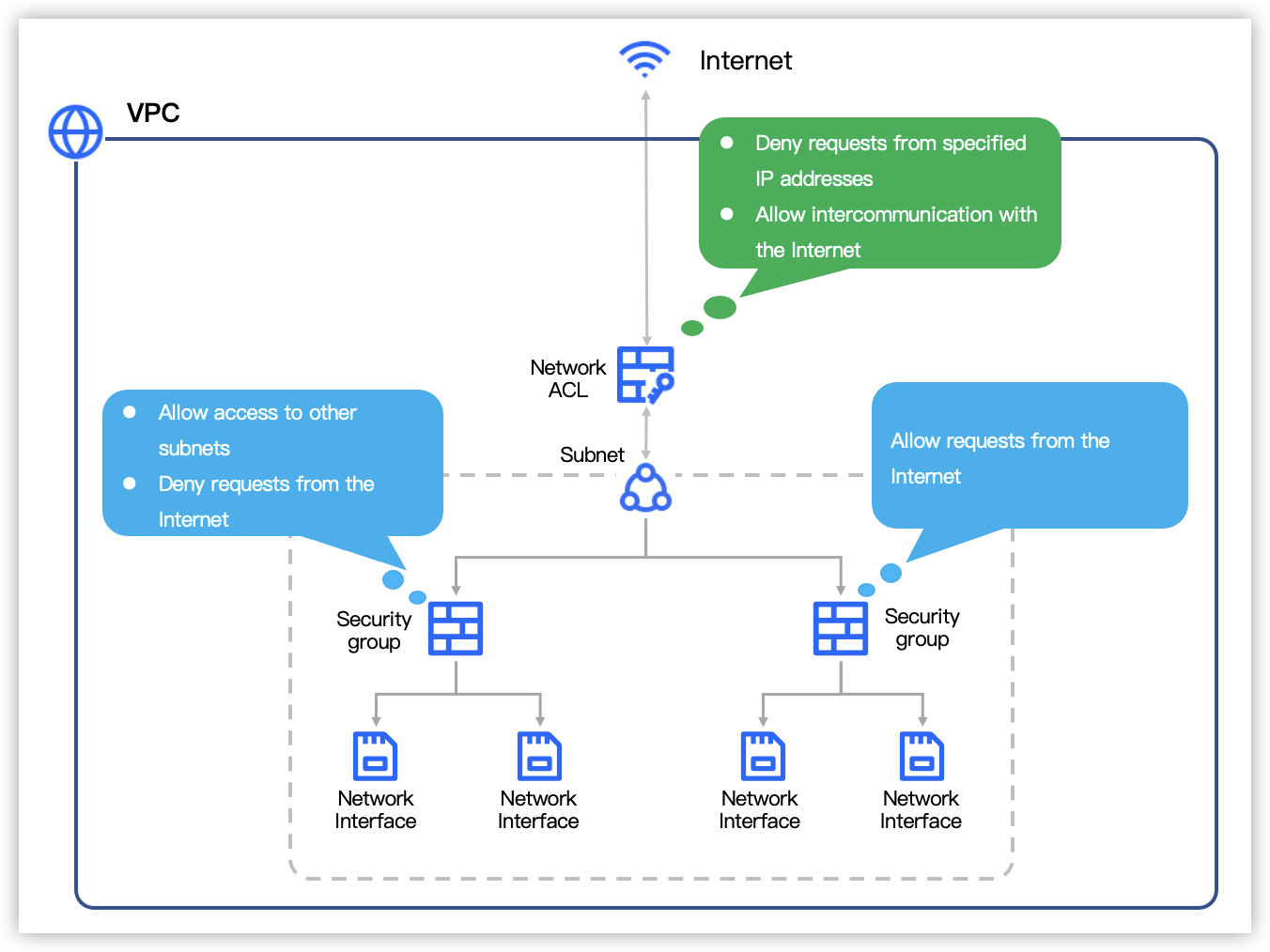
Both VPC security groups and Network ACLs are free resources. We recommend making full use of these two features to strengthen network security protection and ensure business security.
Operations and Maintenance
If your network architecture becomes increasingly complex or if you require refined and standardized network O&M management, we recommend leveraging the flow log and traffic mirror features. The former records traffic directions, while the latter captures specific traffic, helping you to clearly understand network conditions and achieve efficient O&M.
Internet connection
Whether for accessing the internet, enabling private communication between VPCs, or building a hybrid cloud across cloud and on-premises, you can refer to Application scenarios to plan an appropriate network connection.
Last updated: 2026.01.23 17:28:39
All rights reserved © Beijing Volcano Engine Technology Co., Ltd2024
