RDS for MySQL
RDS for MySQL


Document

- Documentation
 RDS for MySQLKernel functionsPerformanceIN predicate performance optimization
 Copy page
 Download PDF
Performance
IN predicate performance optimization
Copy pageDownload PDFIN predicate performance optimization
This topic describes the IN predicate performance optimization feature of RDS for MySQL.
Supported version
- MySQL 5.7 version, and the kernel minor version is MySQL 5.7.44_20250815 and above.
- MySQL 8.0 version, and the kernel minor version is MySQL 8.0.32_20250815 and above.
- MySQL 8.4, with a kernel minor version of MySQL 8.4.7_20260415 or later.
Background
When an equality check is used in a query condition (WHERE or JOIN clause), an index can quickly locate data, which avoids a full table scan and reduces overhead. The performance improvement from an index scan is especially significant for tables with many rows.
When an IN predicate appears in a query condition (WHERE or JOIN clause), an index can also be used for quick lookups to avoid a full table scan and reduce overhead. This is because an IN predicate can be broken down into multiple equality conditions connected by logical ORs.
In the implementation of MySQL Community Edition, a longer IN predicate list requires the optimizer to record more information when generating an index scan plan, which in turn consumes more memory. To control memory usage, MySQL sets a threshold controlled by the range_optimizer_max_mem_size parameter. If creating an index scan plan requires more memory than this threshold, the optimizer will stop and use a full table scan plan instead. When the IN predicate list is long, the optimizer's memory usage may exceed the threshold, causing it to select a less performant full table scan.
Feature description
The IN predicate performance optimization feature rewrites queries with IN predicates during the optimization phase, eliminating the predicate and replacing it with a JOIN on a temporary table. For example, consider the following query with an IN predicate:
It can be rewritten as:
The table tmp_table contains three rows and one column of data, (0), (1), and (2), which correspond to the data in the IN predicate list before the rewrite.
The advantages of this rewrite are:
- If the IN predicate before the rewrite can use an index on the sbtest1 table to quickly find the required data, the rewritten SEMI JOIN can also use the same index on the sbtest1 table to do so.
- Before the rewrite, if the IN predicate list is too long, the optimizer may choose a less performant full table scan for sbtest1 to avoid using too much memory. The rewritten SEMI JOIN eliminates concerns about excessive memory usage because all data from the IN predicate list is placed in a temporary table. This table is initially stored in memory and automatically switches to disk storage if memory usage becomes too high. Therefore, regardless of the original length of the IN predicate list, the rewritten SEMI JOIN can always use the index on the sbtest1 table to quickly locate the required data.
Instructions
Parameter description
This feature adds two new parameters, loose_enable_in_list_optimization and loose_in_list_optimization_threshold, to control when to rewrite. The descriptions of these two parameters are as follows:
To enable this feature, we recommend setting loose_enable_in_list_optimization to AUTO. When a query contains an IN predicate, the feature automatically determines whether to rewrite based on a comprehensive performance evaluation before and after the rewrite. For detailed information on modifying parameters, please refer to Modifying parameters.
Examples
- Set parameters to enable this feature.
- Set loose_enable_in_list_optimization to AUTO to let MySQL automatically decide when to rewrite:
-
- Or, set loose_enable_in_list_optimization to ON and also set loose_in_list_optimization_threshold, which rewrites all IN predicates with a length that reaches the loose_in_list_optimization_threshold value:
-
- Use the EXPLAIN statement to check whether the query is rewritten:
-
When the IN predicate is rewritten, the Extra column in the EXPLAIN output displays IN-list optimization.
Precautions
The rewrite for this feature must meet the following conditions:
- The WHERE or JOIN clause of the query contains an IN predicate.
- The IN predicate list contains only constants, and all constants have the same type.
- The IN predicate must be able to use an index.
- If loose_enable_in_list_optimization is ON, the length of the IN predicate list must be greater than or equal to the value of loose_in_list_optimization_threshold. If loose_enable_in_list_optimization is AUTO, MySQL determines whether to perform the rewrite based on the performance before and after the rewrite.
Performance data
Create a sysbench table sbtest1 with 20,000,000 rows and run the following query to verify its performance:
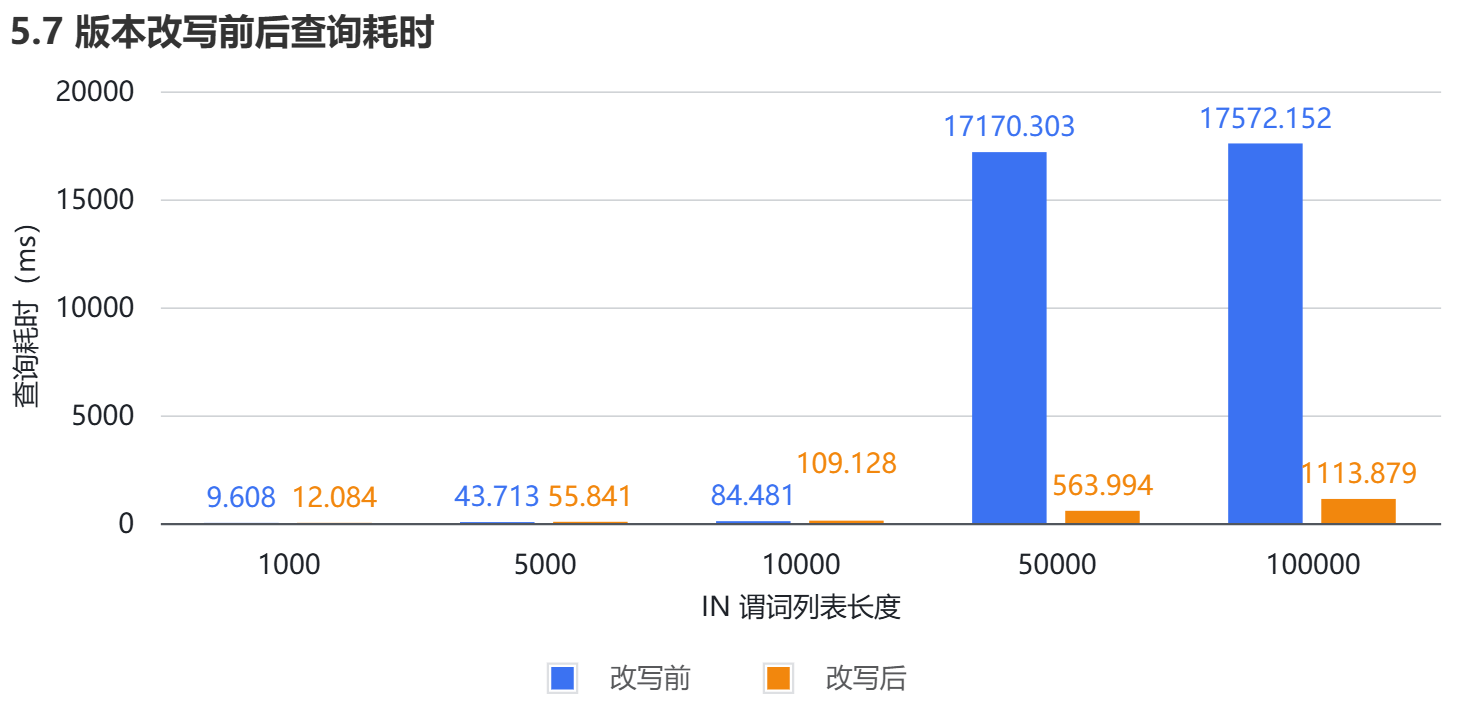
For MySQL 5.7, the execution times before and after rewriting with different IN predicate lengths are as follows:
For MySQL 8.0, the execution times before and after rewriting with different IN predicate lengths are as follows:
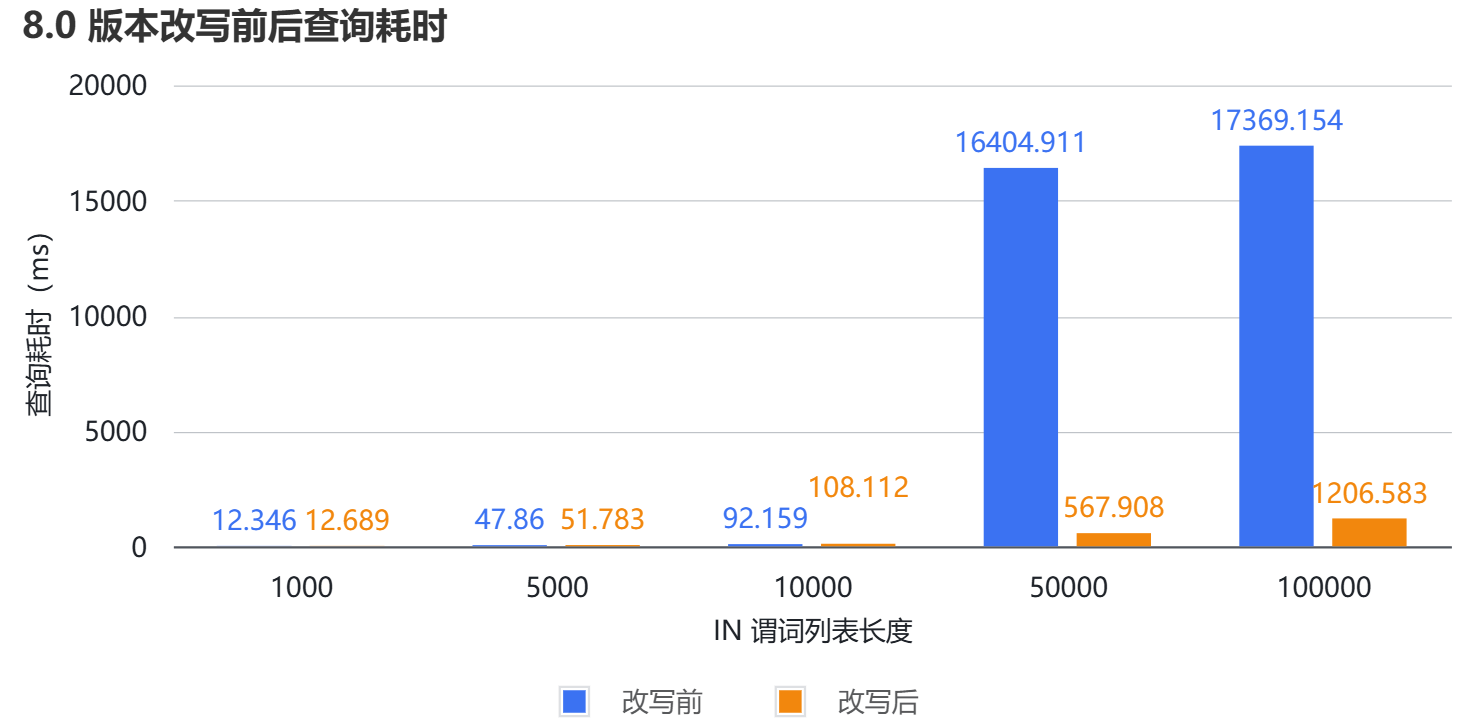
Based on the preceding performance data, the following conclusions can be drawn:
- When the IN predicate list has 10,000 or fewer items, the original query uses an index scan and performs slightly better than the rewritten SEMI JOIN query. This is because the rewriting itself has some overhead, and it introduces an additional temporary table after rewriting, making the execution plan slightly more complex.
- When the IN predicate list length is 50,000 or more, the original query with the IN predicate performs a full table scan due to memory limitations. In this case, its performance is much worse than the rewritten SEMI JOIN query because the rewritten SEMI JOIN query can use an index to quickly locate the required data in sbtest1.
Therefore, when using this feature, we recommend setting loose_enable_in_list_optimization to AUTO. The feature then automatically decides whether to rewrite queries containing IN predicates based on a comprehensive performance comparison.
Last updated: 2026.05.28 15:17:55
All rights reserved © Beijing Volcano Engine Technology Co., Ltd2024
