RDS for MySQL
RDS for MySQL


Document

- Documentation
 RDS for MySQLKernel functionsPerformancePaged query performance optimization
 Copy page
 Download PDF
Performance
Paged query performance optimization
Copy pageDownload PDFPaged query performance optimization
This topic describes the paged query performance optimization feature of RDS for MySQL.
Background
In the community edition of MySQL, limit and offset are processed at the SQL layer. For the following query, the storage engine returns at least 10,000,010 rows, and then the SQL layer returns rows from 10,000,001 to 10,000,010 as the result.
Limit and offset are typically used together in pagination scenarios. In pagination scenarios, especially for deep pagination where the number of rows skipped by offset is much larger than the number of rows retained by limit, the speed of filtering the skipped rows has a significant impact on overall query performance.
RDS for MySQL optimizes this scenario by pushing limit and offset directly to the storage engine. This approach significantly reduces interactions between the storage engine and the SQL layer. Furthermore, if the storage engine scans data through a secondary index, pushing down limit and offset can also greatly reduce the number of table lookups.
Supported version
- MySQL 5.7 version, and the kernel minor version is MySQL 5.7.32_20250615 and above.
- MySQL 8.0 version, and the kernel minor version is MySQL 8.0.32_20250415 and above.
- MySQL 8.4 version, and the kernel minor version is MySQL 8.4.7_20260415 and above.
tip
You can view the kernel minor version of an instance by Viewing instance information. If your instance's kernel minor version is not supported, you can manually upgrade the instance kernel version.
Instructions
Modify the runtime value of the loose_limit_offset_pushdown_threshold parameter to a value other than -1 to enable the paged query performance optimization feature.
Examples
- Example 1: A simple limit + offset query.
-
- Example 2: A limit + offset query with a where clause that can be fully pushed down.
-
- Example 3: A limit + offset query with an order by clause, requiring an index on the ordered column that is used in the query plan.
-
- You can use the EXPLAIN statement to check whether a SQL statement will be optimized for paged query performance.
-
- The preceding statement can be optimized, and the output is as follows (`Using pushed limit offset` indicates that the pagination query performance is optimized):
-

Performance test
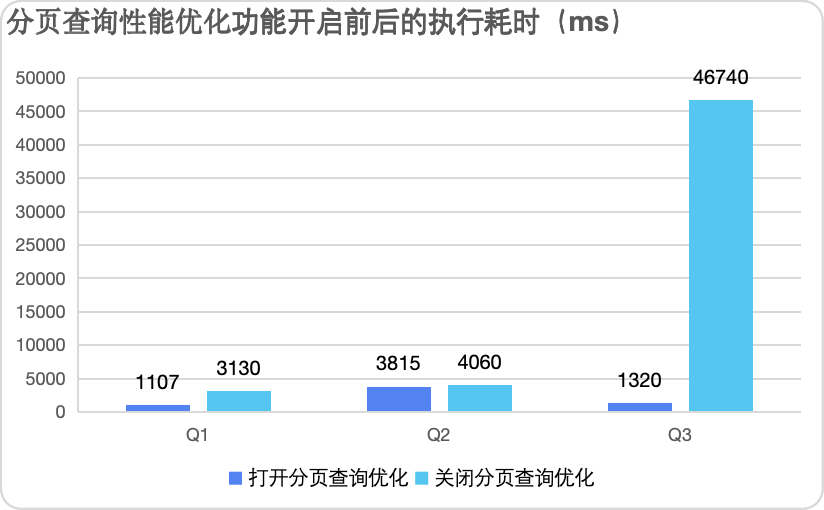
The test environment is a 4-core, 16 GB Exclusive type MySQL 8.0 instance. A sysbench table with 20,000,000 rows is created. The elapsed times for executing examples 1 to 3 before and after this feature is enabled are as follows:
Last updated: 2026.05.28 15:17:49
All rights reserved © Beijing Volcano Engine Technology Co., Ltd2024
