Transit Router
Transit Router
Transit Router


Document
What's new
Product Overview
Product Billing
Getting Started
User Guide
TR instances
Intra-region attachment
Instance sharing
Inter-region management
Bandwidth Package
Route tables
Route policy
Forward policy
QoS management
Traffic qos marking policy
Multicast
Flow logs
Projects and Tags
Best Practices
API reference
TR instances
VPC attachment
VPN attachment
DC gateway attachment
Local peer attachment
Inter-region attachment
Bandwidth Packages
Route tables
Route entry
Association forwarding
Route learning
Route policy
Forwarding policy
Traffic qos marking policy
Traffic qos queue policy
Flow logs
Multicast
- Documentation
 Transit RouterUser GuideRoute tablesForward policyForwarding Policy overview
 Copy page
 Download PDF
Forward policy
Forwarding Policy overview
Copy pageDownload PDFForwarding Policy overview
Overview
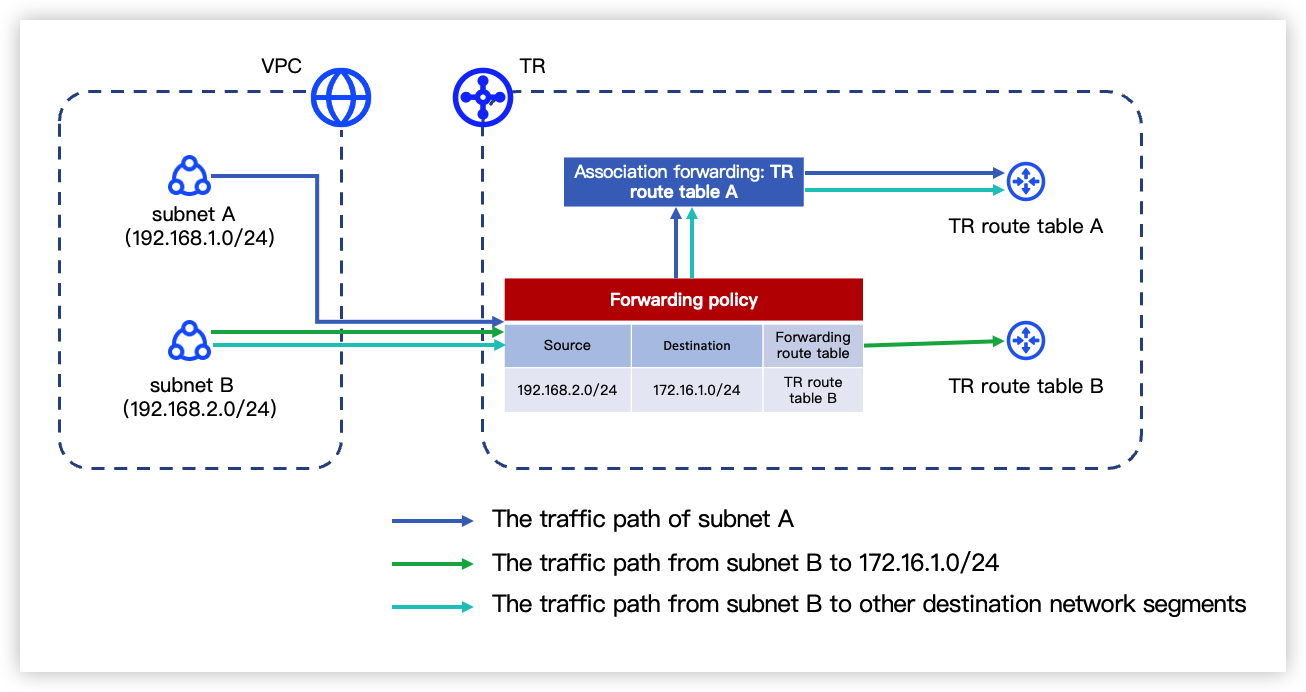
A Forwarding Policy enables source-and-destination-based routing. It can steer traffic from different address pairs within the same network instance through different Transit Router (TR) route tables, thereby creating distinct forwarding paths. For a single attachment, a forwarding policy takes precedence over association forwarding. For example, two subnets in a VPC run different services. Subnet A forwards traffic based on TR Route Table A. Subnet B forwards traffic to the destination CIDR block (172.16.1.0/24) based on TR Route Table B, while traffic from Subnet B to other destination CIDR blocks still forwards based on TR Route Table A. This can be achieved by configuring forwarding policies, as illustrated in the diagram below.
Forwarding policy matching rules
A forwarding policy is a list including multiple policy entries. It determines the forwarding path of traffic based on the source and destination addresses.
The matching rules for the forwarding policy can be summarized as ordered evaluation, and unique match. The description of matching rules is shown below:
- Ordered evaluation: The policy processes all entries sequentially, from the highest to the lowest priority, matching access traffic against each entry.
- A lower priority value indicates a higher precedence for a policy entry.
- Unique match: Upon a successful match with a policy entry, the system forwards traffic according to the TR route table specified in that entry and ignores all subsequent entries. If no match is found in the forwarding policy, the system forwards traffic based on the TR route table associated with the network instance attachment.
Limits
Forwarding policies are not currently supported on inter-region attachments. For more about quotas and usage limits, see Limits.
Last updated: 2026.09.01 11:37:13
All rights reserved © Beijing Volcano Engine Technology Co., Ltd2024
