Elastic Compute Service
Elastic Compute Service
Elastic Compute Service


Document
Elastic Compute Service
What's New
Announcement
OpenAPI related
Pricing and quotas are related
About products and plugins
Feature discontinuation
Overview
Billing
Billable items
Billing methods
Billing methods change
Getting Started
User Guide
Instances
Instance types
X86 Computing
Elastic Bare Metal Server
Heterogeneous Computing
Select instance billing method
Spot instance
Elastic Scheduled Instance
Offsetting Resources
Reserved Instances
Buying ECS instances
Logging in to an instance
Logging in to a Linux instance
Managing instance status
Modifying instance types
Using instance user data and metadata
Instance metadata
Images
Public images
veLinux images
Custom images
Importing custom images
Creating custom images
Image detection
End of life (EOL) of image
Elastic Block Storage
Basic volume operations
Partitioning and formatting a volume
Extending a volume
EBS Agent
Snapshots
Basic snapshot operations
Auto snapshot policies
DataInsights
Network
Network interface and IP address
IP Address
IPv4 address
Security group
Security
Passwords and key pairs
Deployment and scaling
Monitoring
Monitoring metrics
Event monitoring
Local volume event O&M
Method 1: Solve the local volume failure by replacing the faulty volume
O&M
Cloud assistant
Managing agents
Process choreography
Common operation and maintenance tasks
Batch operations on instances
Batch operations on EBS Volumes
Batch operations on images
Temporary upgrade of bandwidth
Managing application updates
orchestration plan
Patch management
Managing patch plans
Managing patch baselines
IAM
Tags and projects
Best Practices
AI applications
OpenClaw (formerly Moltbot)
Quickly deploying OpenClaw via application templates
Quickly deploying OpenClaw via marketplace images
Manually deploying OpenClaw
Self-service website creation
Building environments
Building a Web environment (Windows)
Building applications
Building FTP site
Deploying databases
Building game servers
Building websites
Building a WordPress blog
Building multiple websites
Manage software sources for Linux instances
AIGC practices
Performance test
Network performance test
Instance configuration
Setting up AD Domain Services on Windows OS
Windows Multi - User Login
Changing screen resolution
Instance data
Uploading or downloading files
Data restoration
ECS instance local time synchronization
Volume
Monitoring
Security
Images
Kernel fine-tuning
O&M
Troubleshooting
Remote log in issue
Linux operating system issue
Windows operating system issue
SSH log in issue
Operating system issue
veLinux operating system issue
Linux operating system issue
Windows operating system issue
Instance status issue
Instance unable to start issue
High instance load issue
GPU instances issue
Network connection issue
Network configuration issue
Storage classes issue
EBS Volume issue
Local Disk issue
Logs and monitoring issue
Third - party software issue
API Reference
Regions and availability zones
Instances
Images
HPC clusters
Key pairs
Tags
Volumes
Reserved storage capacity
Snapshot
Auto snapshot policy
Monitoring
Deployment sets
Launch templates
Cloud assistant
Patch management
SDK reference
CLI Reference
FAQ
Dedicated Host DDH
What's New
Billing
User Guide
Manage Dedicated Host
Manage Dedicated Host Cluster
Manage ECS instances
Monitoring and O&M
API reference
proprietary host
- Documentation
 Elastic Compute ServiceElastic Compute ServiceBest PracticesSelf-service website creationBuilding applicationsSetting up Docker
 Copy page
 Download PDF
Building applications
Setting up Docker
Copy pageDownload PDFSetting up Docker
This topic describes how to deploy Docker CE on Linux instances, as well as common Docker operations and the image creation process.
About Docker
Docker is an open-source application container engine. It packages applications and their dependencies into virtual containers, which can run on any computer with Linux, Windows, or macOS. This capability allows applications to operate seamlessly across diverse environments, including local systems, public clouds, and private clouds. For more information, visit Docker docs.
The following items describe the main components of Docker:
- Docker client
- Docker Daemon
- Docker image
- Docker container
Prerequisites
- You have purchased an ECS instance and associated an EIP with it.
- The ECS instance status is Running.
Procedure
Install Docker
veLinux 1.0/veLinux 2.0
CentOS 7.x/Stream 8/Stream 9
Ubuntu 18.04/20.04/22.04/24.04
Debian 10/11/12
- Execute the following command to install the packages that allow APT to use software repositories over HTTPS:
- sudo apt install -y ca-certificates curl gnupg lsb-release
- Execute the following command to add the official Docker GPG key.
- sudo mkdir -p /etc/apt/keyringscurl -fsSL https://mirrors.ivolces.com/docker/linux/debian/gpg | sudo gpg --dearmor -o /etc/apt/keyrings/docker.gpg
- Execute the following command to add the Docker software repository information.
- veLinux 1.0veLinux 2.0echo "deb [arch=$(dpkg --print-architecture) signed-by=/etc/apt/keyrings/docker.gpg] https://mirrors.ivolces.com/docker/linux/debian buster stable" | sudo tee /etc/apt/sources.list.d/docker.list > /dev/nullecho "deb [arch=$(dpkg --print-architecture) signed-by=/etc/apt/keyrings/docker.gpg] https://mirrors.ivolces.com/docker/linux/debian bookworm stable" | sudo tee /etc/apt/sources.list.d/docker.list > /dev/null
- Execute the following command to update the software repository.
- sudo apt update
- Execute the following command to install Docker CE.
- sudo apt install -y docker-ce docker-ce-cli containerd.io docker-compose-plugin
- Execute the following command to run Docker.
- systemctl start docker
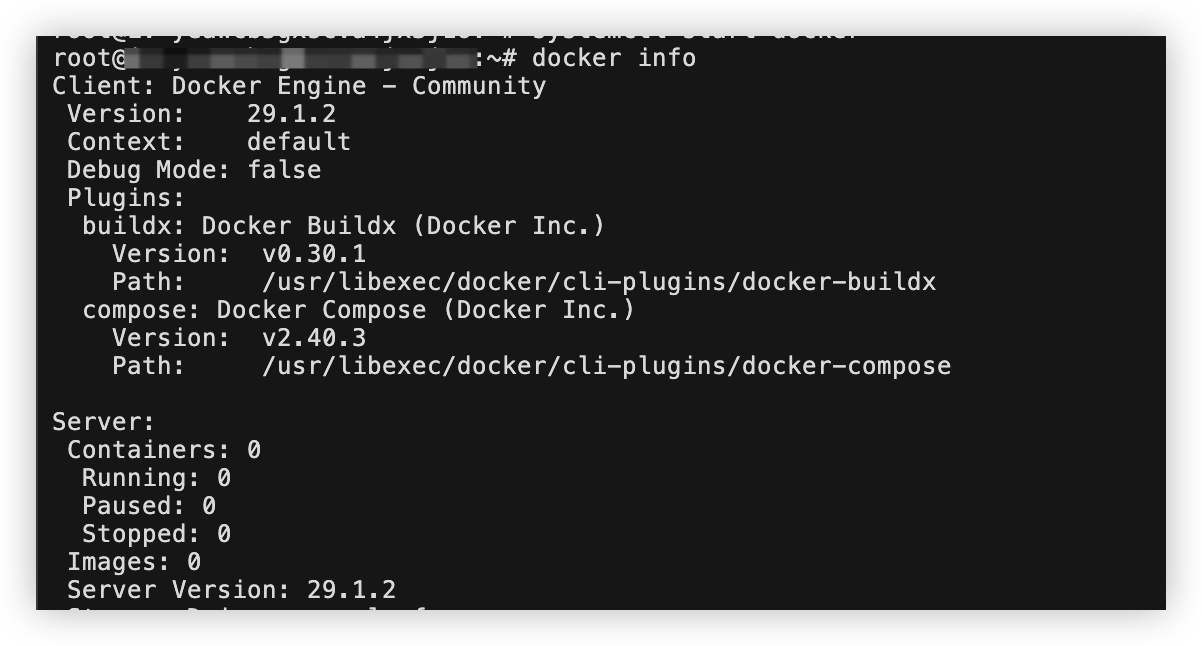
- Execute the following command to check whether Docker is installed as expected.
- docker info
- If the output is as shown below, Docker has been successfully installed.
-
- Execute the following command to install the required system tools.
- sudo yum install -y yum-utils
- Execute the following command to add the Docker software repository information.
- sudo yum-config-manager --add-repo https://mirrors.ivolces.com/docker/linux/centos/docker-ce.reposudo sed -i 's+download.docker.com+mirrors.ivolces.com/docker+' /etc/yum.repos.d/docker-ce.repo
- Execute the following command to update the software repository.
- sudo yum makecache
- Execute the following command to install Docker CE.
- sudo yum install -y docker-ce docker-ce-cli containerd.io docker-buildx-plugin docker-compose-plugin
- Execute the following command to run Docker.
- systemctl start docker
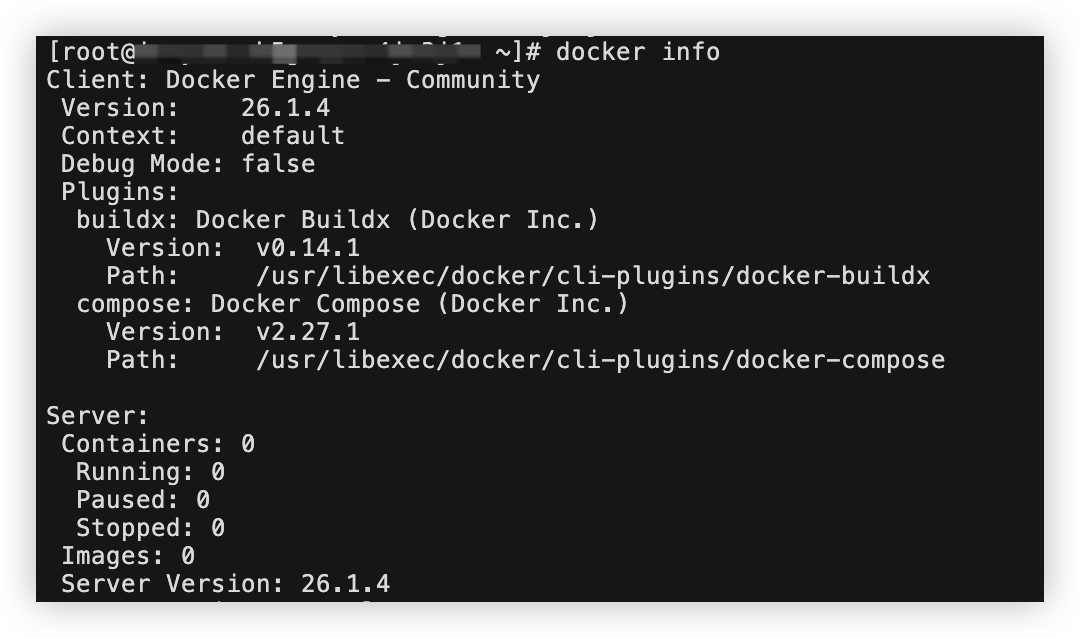
- Execute the following command to check whether Docker is installed as expected.
- docker info
- If the output is as shown below, Docker has been successfully installed.
-
- Execute the following command to install the packages that allow APT to use software repositories over HTTPS:
- sudo apt install -y ca-certificates curl gnupg lsb-release
- Execute the following command to add the official Docker GPG key.
- sudo mkdir -p /etc/apt/keyringscurl -fsSL https://mirrors.ivolces.com/docker/linux/ubuntu/gpg | sudo gpg --dearmor -o /etc/apt/keyrings/docker.gpg
- Execute the following command to add the Docker software repository information.
- echo "deb [arch=$(dpkg --print-architecture) signed-by=/etc/apt/keyrings/docker.gpg] https://mirrors.ivolces.com/docker/linux/ubuntu $(lsb_release -cs) stable" | sudo tee /etc/apt/sources.list.d/docker.list > /dev/null
- Execute the following command to update the software repository.
- sudo apt update
- Execute the following command to install Docker CE.
- sudo apt install -y docker-ce docker-ce-cli containerd.io docker-compose-plugin
- Execute the following command to run Docker.
- systemctl start docker
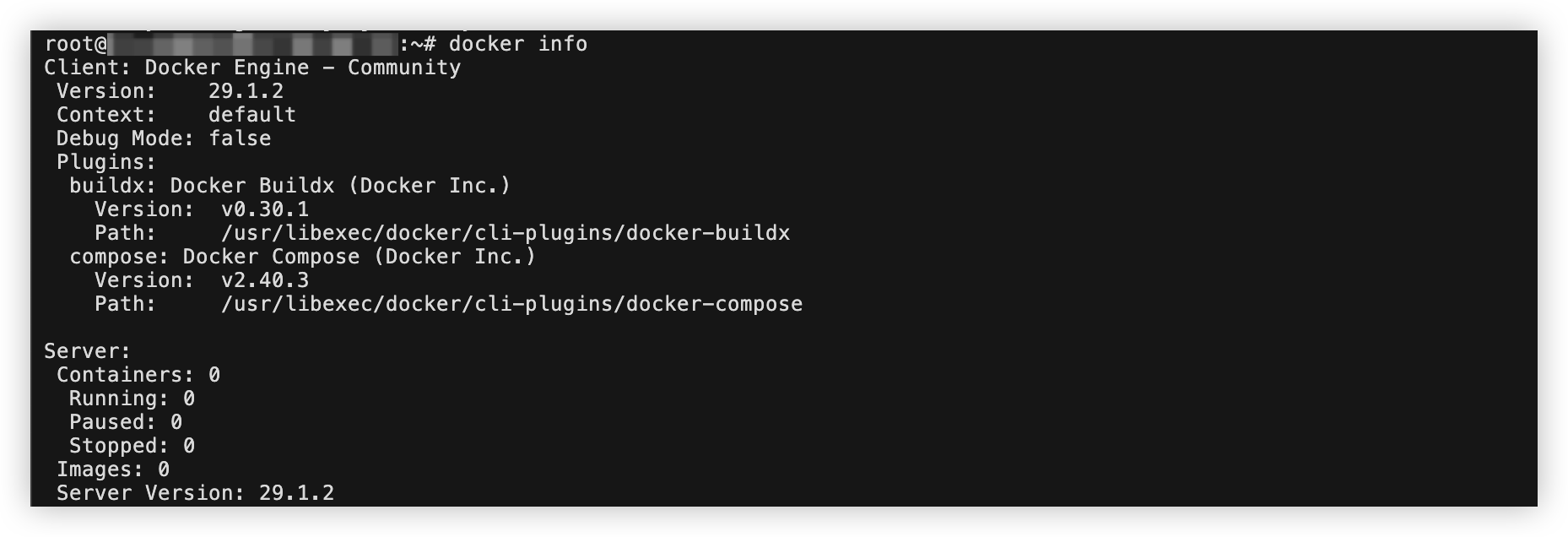
- Execute the following command to check whether Docker is installed as expected.
- docker info
- If the output is as shown below, Docker has been successfully installed.
-
- Execute the following command to install the packages that allow APT to use software repositories over HTTPS:
- sudo apt install -y ca-certificates curl gnupg lsb-release
- Execute the following command to add the official Docker GPG key.
- sudo mkdir -p /etc/apt/keyringscurl -fsSL https://mirrors.ivolces.com/docker/linux/debian/gpg | sudo gpg --dearmor -o /etc/apt/keyrings/docker.gpg
- Execute the following command to add the Docker software repository information.
- echo "deb [arch=$(dpkg --print-architecture) signed-by=/etc/apt/keyrings/docker.gpg] https://mirrors.ivolces.com/docker/linux/debian $(lsb_release -cs) stable" | sudo tee /etc/apt/sources.list.d/docker.list > /dev/null
- Execute the following command to update the software repository.
- sudo apt update
- Execute the following command to install Docker CE.
- sudo apt install -y docker-ce docker-ce-cli containerd.io docker-compose-plugin
- Execute the following command to run Docker.
- systemctl start docker
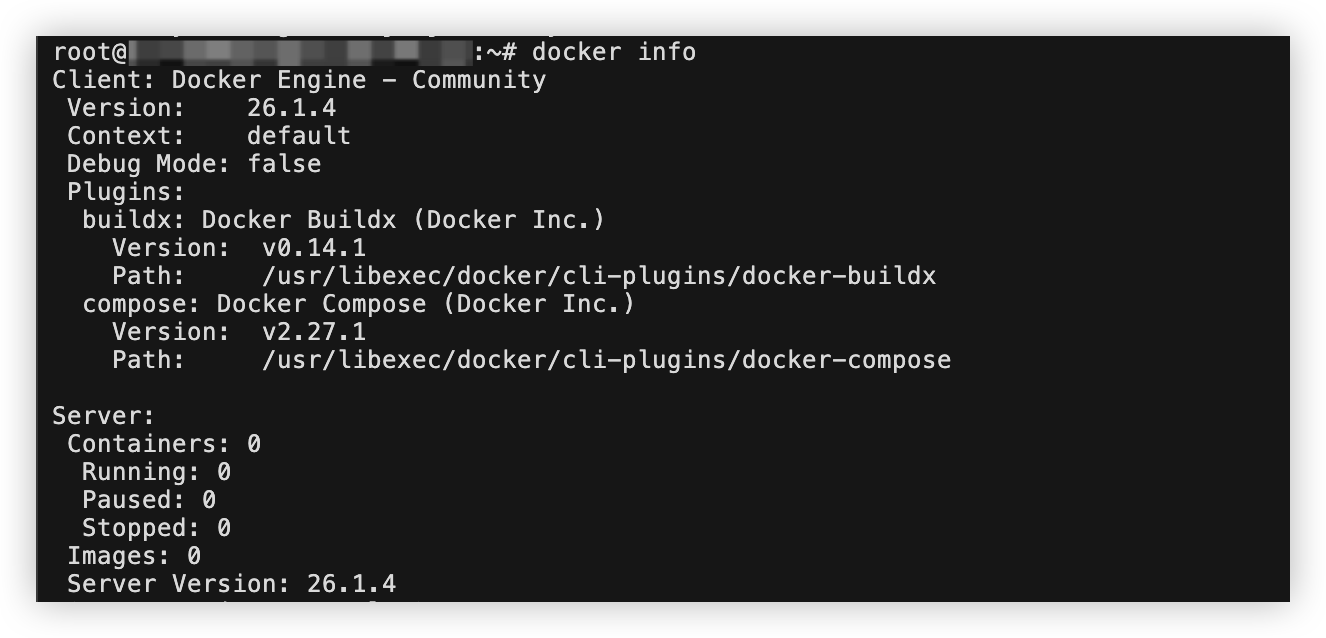
- Execute the following command to check whether Docker is installed as expected.
- docker info
- If the output is as shown below, Docker has been successfully installed.
-
Use Docker
Manage the Docker daemon
systemctl start docker # Run the Docker daemon.
systemctl stop docker # Stop the Docker daemon.
systemctl restart docker # Restart the Docker daemon.
Manage mirror sites
When image pulls from the official Docker repository fail, you can configure one or multiple reliable and available mirror sites. Docker will pull images from the mirror site you specify, improving pull reliability and speed.
- Edit the Docker configuration file.
- sudo vim /etc/docker/daemon.json
- Press i to enter edit mode, and enter the mirror site you need in the registry-mirrors structure.
tip
Replace https://registry-1.docker.io and https://registry-2.docker.io with the mirror sites you need. Separate multiple sources with ,.
- {"registry-mirrors": ["https://registry-1.docker.io","https://registry-2.docker.io"]}
- Press the Esc key to exit edit mode, enter :wq, and then press Enter to save and exit the file.
- Execute the following command to restart the Docker service.
- sudo systemctl daemon-reload && sudo systemctl restart docker
Manage images
- Pull images
- In the example provided in this topic, the Ubuntu image is used.
- docker pull ubuntu
- View the existing images
- docker images
-

- Forcibly delete an image
- docker rmi -f ubuntu
- After you delete an image, you can execute the docker images command to check whether the image is deleted.
-

Manage containers
- Enter a container
- docker run -it <ImageId> /bin/bash
- You can execute the docker images command to get <ImageId> in the preceding command.
- Exit a container
- Execute the exit command to exit the current container.
- Run a container in the background
- docker run -d --name ubuntu ImageId
tip
The --name option specifies ubuntu as the container name.
- Enter a container running in the background
- docker exec -it <Container ID> /bin/bash
tip
Replace <Container ID> with the actual container ID, which you can obtain by executing the docker ps command.
- Create an image from a container
- docker commit <Container ID OR Container Name> [<Repository Name>[:<Tags>]]
tip
Replace <Container ID OR Container Name> with the actual container ID or name, <Repository Name> with the actual repository name, and <Tags> with the actual repository tags. Example: docker commit 097fdd5e**** dockertest/ubuntu:latest.
Create an image
- Execute the following command to create and edit a Dockerfile.
- vim Dockerfile
- Press i to enter edit mode and add the following content.
- FROM nginxRUN echo '<h1>Hello, Docker!</h1>' > /usr/share/nginx/html/index.html
- The following items describe simple instructions in the Dockerfile. For more information, visit the official website.
- FROM statement: Indicates that the Nginx image is used as the base image. In a Dockerfile, the FROM instruction is required and must be the first instruction.
- RUN statement: The format is RUN <command>. For example, if the command in the statement is echo "Hello, Docker!", Hello, Docker! is displayed after you execute the statement.
- Press the Esc key, enter :wq, and then press Enter to save and exit the Dockerfile.
- Execute the following command to create an image.
- docker build -t nginx:v1 . # . specifies the path to the Dockerfile and cannot be omitted.docker images # Check whether the image is created.
-

- Execute the following commands to run and view the containers.
- docker run -d nginx:v1 # Run containers in the background.docker ps # View currently running containers.docker ps -a # View all containers, including containers that are not running.docker logs CONTAINER ID/NAMES # If no running containers are displayed, use the container ID or name to check the startup logs for troubleshooting purposes.
- Execute the following command to create an image.
- docker commit bd0d3e7e**** nginxtest:v1 # Add the container ID, along with the name and version number of the new image, after the commit parameter.docker images # List local (downloaded and locally created) images.
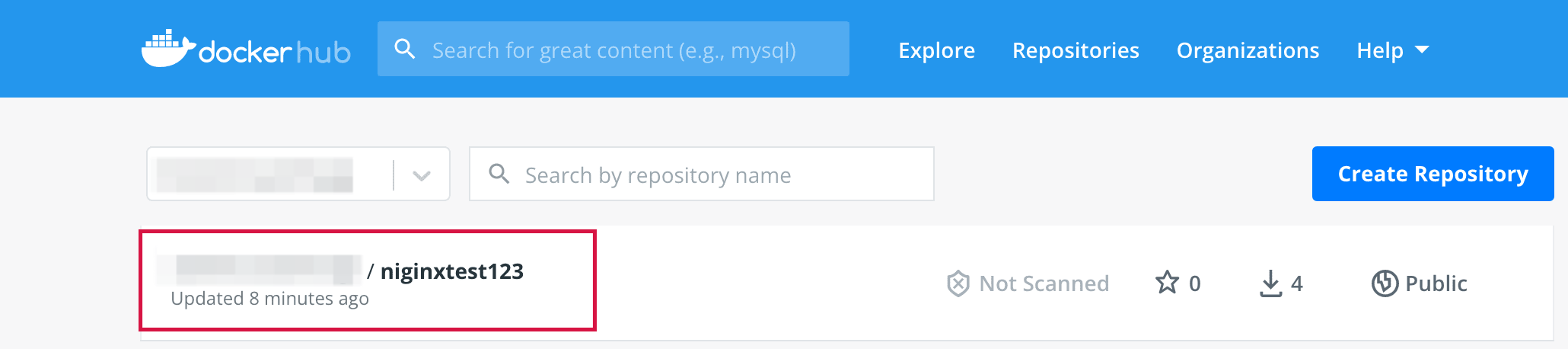
- Push the image to the remote repository.
- By default, the image is pushed to Docker Hub. You need to first log in to Docker, associate tags with the image, and name the image in the format of [Docker User Name]/[Image Name]:[Tag]. The push is complete.
- docker logindocker tag [ImageId] [Docker User Name]/[Image Name]:[Tag]docker push [Docker User Name]/[Image Name]:[Tag]
tip
Replace [Docker User Name] with your actual Docker username, [Image Name] with the actual image name, and [Tag] with the actual image tag.
- Log in to Docker Hub to view the image.
-
Last updated: 2026.06.18 17:48:26
All rights reserved © Beijing Volcano Engine Technology Co., Ltd2024
