Elastic Compute Service
Elastic Compute Service
Elastic Compute Service


Document
Elastic Compute Service
What's New
Announcement
OpenAPI related
Pricing and quotas are related
About products and plugins
Feature discontinuation
Overview
Billing
Billable items
Billing methods
Billing methods change
Getting Started
User Guide
Instances
Instance types
X86 Computing
Elastic Bare Metal Server
Heterogeneous Computing
Select instance billing method
Spot instance
Elastic Scheduled Instance
Offsetting Resources
Reserved Instances
Buying ECS instances
Logging in to an instance
Logging in to a Linux instance
Managing instance status
Modifying instance types
Using instance user data and metadata
Instance metadata
Images
Public images
veLinux images
Custom images
Importing custom images
Creating custom images
Image detection
End of life (EOL) of image
Elastic Block Storage
Basic volume operations
Partitioning and formatting a volume
Extending a volume
EBS Agent
Snapshots
Basic snapshot operations
Auto snapshot policies
DataInsights
Network
Network interface and IP address
IP Address
IPv4 address
Security group
Security
Passwords and key pairs
Deployment and scaling
Monitoring
Monitoring metrics
Event monitoring
Local volume event O&M
Method 1: Solve the local volume failure by replacing the faulty volume
O&M
Cloud assistant
Managing agents
Process choreography
Common operation and maintenance tasks
Batch operations on instances
Batch operations on EBS Volumes
Batch operations on images
Temporary upgrade of bandwidth
Managing application updates
orchestration plan
Patch management
Managing patch plans
Managing patch baselines
IAM
Tags and projects
Best Practices
AI applications
OpenClaw (formerly Moltbot)
Quickly deploying OpenClaw via application templates
Quickly deploying OpenClaw via marketplace images
Manually deploying OpenClaw
Self-service website creation
Building environments
Building a Web environment (Windows)
Building applications
Building FTP site
Deploying databases
Building game servers
Building websites
Building a WordPress blog
Building multiple websites
Manage software sources for Linux instances
AIGC practices
Performance test
Network performance test
Instance configuration
Setting up AD Domain Services on Windows OS
Windows Multi - User Login
Changing screen resolution
Instance data
Uploading or downloading files
Data restoration
ECS instance local time synchronization
Volume
Monitoring
Security
Images
Kernel fine-tuning
O&M
Troubleshooting
Remote log in issue
Linux operating system issue
Windows operating system issue
SSH log in issue
Operating system issue
veLinux operating system issue
Linux operating system issue
Windows operating system issue
Instance status issue
Instance unable to start issue
High instance load issue
GPU instances issue
Network connection issue
Network configuration issue
Storage classes issue
EBS Volume issue
Local Disk issue
Logs and monitoring issue
Third - party software issue
API Reference
Regions and availability zones
Instances
Images
HPC clusters
Key pairs
Tags
Volumes
Reserved storage capacity
Snapshot
Auto snapshot policy
Monitoring
Deployment sets
Launch templates
Cloud assistant
Patch management
SDK reference
CLI Reference
FAQ
Dedicated Host DDH
What's New
Billing
User Guide
Manage Dedicated Host
Manage Dedicated Host Cluster
Manage ECS instances
Monitoring and O&M
API reference
proprietary host
- Documentation
 Elastic Compute ServiceElastic Compute ServiceBillingBilling methodsElastic Scheduled Instances
 Copy page
 Download PDF
Billing methods
Elastic Scheduled Instances
Copy pageDownload PDFElastic Scheduled Instances
Elastic Scheduled Instances (ESI) are pay-as-you-go instances that support advance reservation and automatic delivery at the scheduled time. They are applicable for scenarios that require flexibility and ensure stable supply of resources. This topic describes the resource delivery methods and fee settlement rules for ESI.
tip
- Currently, only accounts that have completed enterprise real-name authentication can use this feature. How can personal authentication be upgraded to enterprise authentication?
- For information on the operation process, applicable scenarios, limits, and user guide for ESI, refer to Elastic Scheduled Instances (ESI) overview.
- For ESI, a minimum 1-hour consumption policy is implemented. Regardless of whether the instance is released within the first hour after creation, a one-hour bill will be issued and the fee will be charged. If the ESI is used for more than 1 hour, billing is based on your actual usage.
Reservation and delivery
You can reserve an ESI 1–8 hours in advance (China (Beijing) region only) or 3–8 hours in advance (China (Shanghai) and China (Guangzhou) regions). When reserving, you are required to specify a delivery time period (10 minutes as a time period). For example, the current time is 17:42, the earliest delivery time period in the China (Beijing) region is 18:50-19:00, which is 1 hour later. The latest delivery time period is 01:40-01:50 (+1 day), which is 8 hours later.
After you have reserved an ESI, the system will generate an order for this purchase within the resource delivery time period and automatically creates an ESI. Once the instance is created, billing based on the ESI price starts.
Prices and billing rules
Prices
- Compared with Pay-as-you-go, ESI allows you to save approximately 27% of the costs of compute resources (vCPU and memory). The fees for storage and network are the same as Pay-as-you-go prices. The billing rules are as follows:
- For billing rules for system volume and data volume, refer to Pay-as-you-go.
- Network: For billing rules of EIP, refer to EIP pay-as-you-go.
- The prices of ESIs vary based on specification. Please refer to the prices displayed on the ESI purchase page in the ECS console.
- Reserved Instances (RI) can not be used to deduct the costs of compute resources (vCPU and memory) for ESI.
Billing rules
During the use of ESI, you need to pay the following fees:
- Actual usage duration < 1 hour: The 1-hour minimum consumption policy is implemented. If the instance is released within 1 hour after creation, a bill will be issued and fee will be charged based on 1 hour of usage. For details, please refer to Fee settlement example.
- Actual usage duration ≥ 1 hour: The 1-hour minimum consumption policy is not applicable. Billing is done per second based on actual usage time, and a bill is issued hourly.
tip
- Actual usage duration: The duration from when the ESI is successfully created to when it is released. Billing ends after the instance is released.
- Instance release: ESI is not released automatically (except for resources release due to arrears). You can manually delete the instance after business ends.
- Bill issued hourly: Billing for ESI is settled every hour (UTC+8). After this, the next settlement cycle starts. If the available amount in your account (including account balance and vouchers) is less than the outstanding bill, you will receive a notification via SMS or email regarding insufficient balance.
Fee settlement example
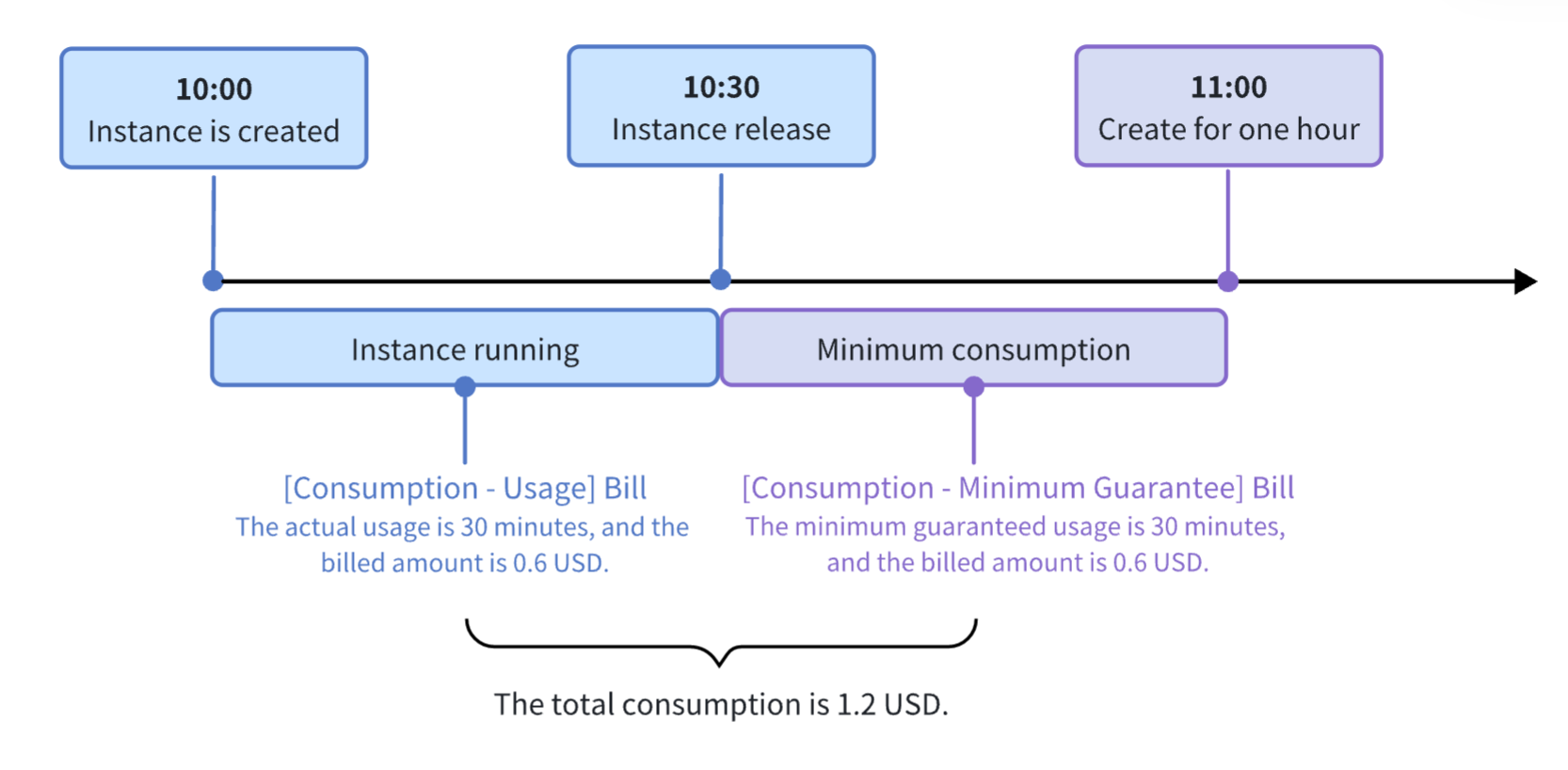
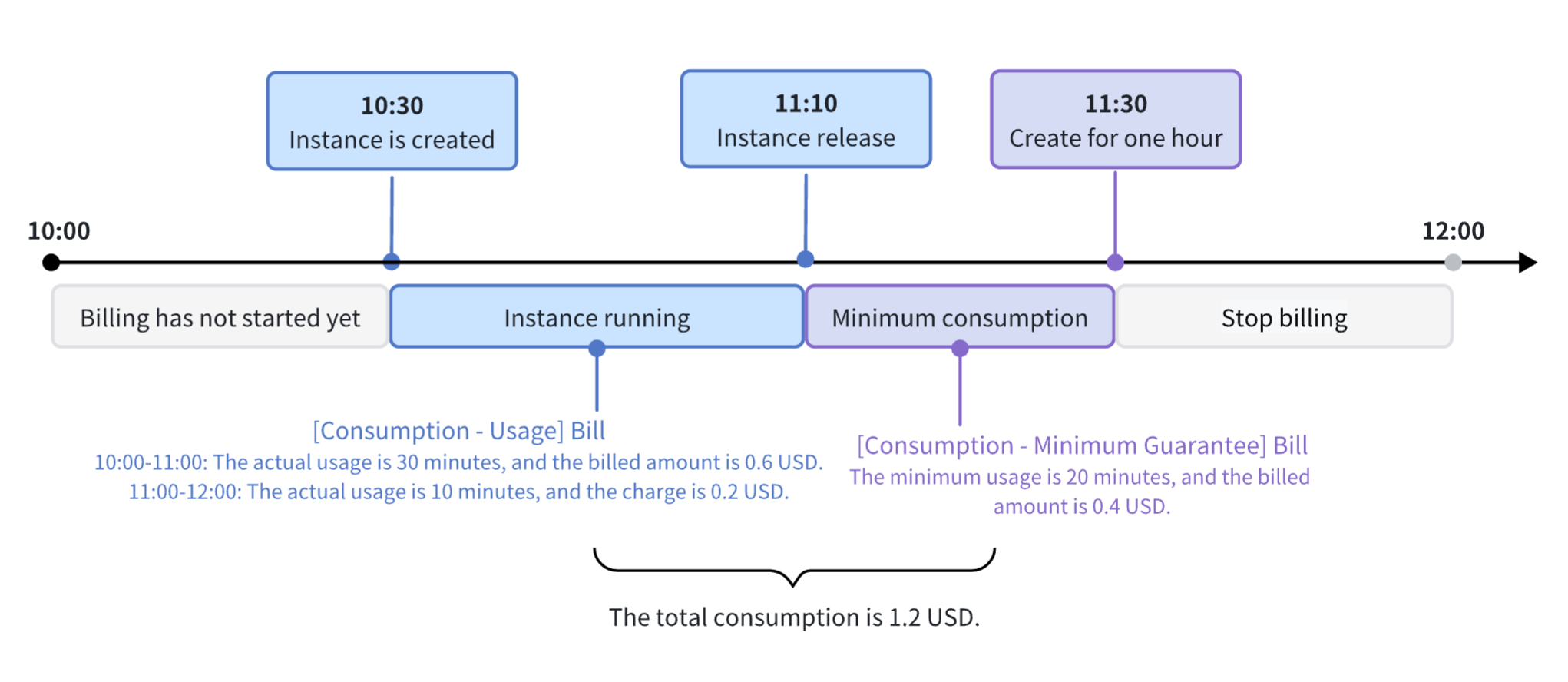
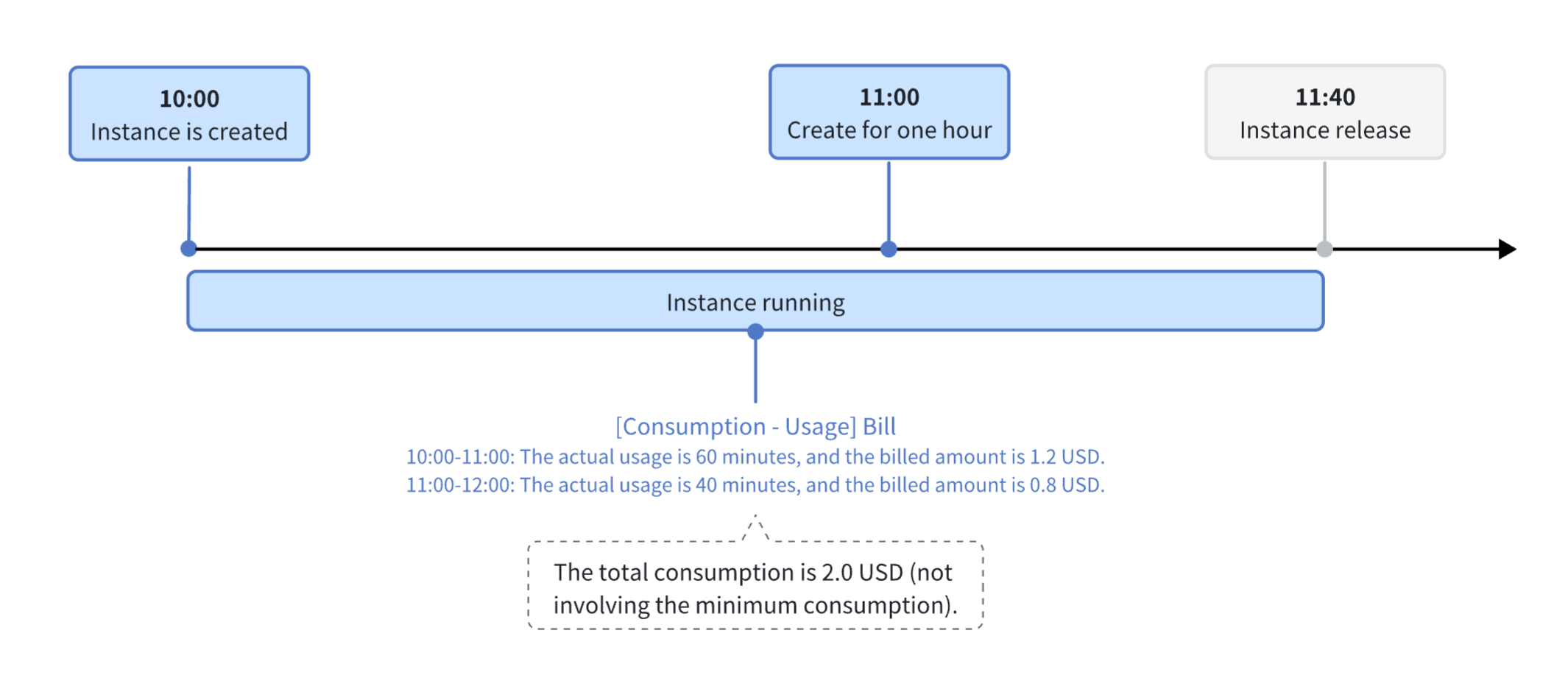
Assuming the price of an ESI is 1.2 RMB/hour, the corresponding consumption in different scenarios is shown in the figures below.
tip
Since a 1-hour minimum consumption policy is implemented for ESI, two bills based on actual usage and minimum consumption are issued:
- [Consumption-Minimum] bill: Records the cost for minimum consumption due to the usage duration not reaching 1 hour limit for Elastic Scheduled Instances. Minimum consumption = 60 minutes - actual usage.
- [Consumption-Usage] bill: Records the actual usage of the instance and the corresponding cost.
Scenario 1: Actual usage duration is less than 1 hour and does not go beyond 1 settlement cycle, involving minimum consumption.
Scenario 2: Actual usage usage duration is less than 1 hour but spans 2 settlement cycles, involving minimum consumption.
Scenario 3: Actual usage duration exceeds 1 hour, not involving minimum consumption.
Last updated: 2026.06.18 16:37:45
All rights reserved © Beijing Volcano Engine Technology Co., Ltd2024
