Elastic Compute Service
Elastic Compute Service
Elastic Compute Service


Document
Elastic Compute Service
What's New
Announcement
OpenAPI related
Pricing and quotas are related
About products and plugins
Feature discontinuation
Overview
Billing
Billable items
Billing methods
Billing methods change
Getting Started
User Guide
Instances
Instance types
X86 Computing
Elastic Bare Metal Server
Heterogeneous Computing
Select instance billing method
Spot instance
Elastic Scheduled Instance
Offsetting Resources
Reserved Instances
Buying ECS instances
Logging in to an instance
Logging in to a Linux instance
Managing instance status
Modifying instance types
Using instance user data and metadata
Instance metadata
Images
Public images
veLinux images
Custom images
Importing custom images
Creating custom images
Image detection
End of life (EOL) of image
Elastic Block Storage
Basic volume operations
Partitioning and formatting a volume
Extending a volume
EBS Agent
Snapshots
Basic snapshot operations
Auto snapshot policies
DataInsights
Network
Network interface and IP address
IP Address
IPv4 address
Security group
Security
Passwords and key pairs
Deployment and scaling
Monitoring
Monitoring metrics
Event monitoring
Local volume event O&M
Method 1: Solve the local volume failure by replacing the faulty volume
O&M
Cloud assistant
Managing agents
Process choreography
Common operation and maintenance tasks
Batch operations on instances
Batch operations on EBS Volumes
Batch operations on images
Temporary upgrade of bandwidth
Managing application updates
orchestration plan
Patch management
Managing patch plans
Managing patch baselines
IAM
Tags and projects
Best Practices
AI applications
OpenClaw (formerly Moltbot)
Quickly deploying OpenClaw via application templates
Quickly deploying OpenClaw via marketplace images
Manually deploying OpenClaw
Self-service website creation
Building environments
Building a Web environment (Windows)
Building applications
Building FTP site
Deploying databases
Building game servers
Building websites
Building a WordPress blog
Building multiple websites
Manage software sources for Linux instances
AIGC practices
Performance test
Network performance test
Instance configuration
Setting up AD Domain Services on Windows OS
Windows Multi - User Login
Changing screen resolution
Instance data
Uploading or downloading files
Data restoration
ECS instance local time synchronization
Volume
Monitoring
Security
Images
Kernel fine-tuning
O&M
Troubleshooting
Remote log in issue
Linux operating system issue
Windows operating system issue
SSH log in issue
Operating system issue
veLinux operating system issue
Linux operating system issue
Windows operating system issue
Instance status issue
Instance unable to start issue
High instance load issue
GPU instances issue
Network connection issue
Network configuration issue
Storage classes issue
EBS Volume issue
Local Disk issue
Logs and monitoring issue
Third - party software issue
API Reference
Regions and availability zones
Instances
Images
HPC clusters
Key pairs
Tags
Volumes
Reserved storage capacity
Snapshot
Auto snapshot policy
Monitoring
Deployment sets
Launch templates
Cloud assistant
Patch management
SDK reference
CLI Reference
FAQ
Dedicated Host DDH
What's New
Billing
User Guide
Manage Dedicated Host
Manage Dedicated Host Cluster
Manage ECS instances
Monitoring and O&M
API reference
proprietary host
- Documentation
 Elastic Compute ServiceElastic Compute ServiceUser GuideElastic Block StorageEncrypted volumes
 Copy page
 Download PDF
Elastic Block Storage
Encrypted volumes
Copy pageDownload PDFEncrypted volumes
To meet data security and compliance requirements and effectively defend against threats such as physical theft and unauthorized access, you can encrypt your ECS volumes using Key Management Service (KMS). This ensures the confidentiality and integrity of your business data.
Notes
- Encrypted volumes are currently in closed beta. Please contact your account manager for access.
- The volumes discussed in this topic are all data volumes. System volumes are automatically created and attached when instances are created, and cannot be created independently.
- Make sure you have activated KMS. For instructions, see Key Management Quick Start.
- Encrypted volumes are currently only available in China (Shanghai). If you need to use them in another region, please contact your account manager for assistance.
How it works
An encrypted volume uses two encryption keys to ensure the security of your data:
- Data key: Used to encrypt and decrypt volume data.
- KMS-managed key: Used to encrypt and decrypt the data key.
When an encrypted volume is created, the data key is encrypted with the KMS key and stored within the volume. During instance startup, ECS requests that KMS decrypt the data key. The decrypted plaintext data key is then loaded into memory and used to encrypt or decrypt data.
KMS keys come in two types:
- Service key: A key that is automatically created and managed by KMS for ECS with the alias Default Service Key(managed_ebs_key). This key meets basic data encryption requirements and is easy to use since you do not need to manage it throughout its lifecycle.
- Customer master key: A key that you import or create in KMS, over which you have full control. It is ideal if you need strong data security and want to manage tasks such as key rotation, disabling, and deletion yourself.
Creating an encrypted volume
- In the ECS console, go to the Volumes page and click "Create volume".
- On the "Create volume" page, check the box for "Encryption".
tip
- If you have not allowed ECS to access KMS, click "Unauthorized, authorize access to KMS first".
- On the "Cross-service access request" page, verify your IAM role and click "Authorize now". Wait three seconds after authorization is complete, and the system will automatically return to the "Create volume" page.
- On the "Create volume" page, click the "Please select" drop‑down list and choose the KMS key you want to use.
- Configure other parameters based on your needs. For descriptions of volume parameters, see Creating a volume.
- Under "Order details", check the box that says "I have read and agree to Elastic Compute Service Terms of Service", and click "Create volume" to submit your order.
Creating an encrypted volume from an encrypted snapshot
When you create an encrypted volume from an encrypted snapshot, the new volume initially contains all of the snapshot's data. Steps:
- In the ECS console, go to the Volumes page and click "Create volume".
- On the "Create volume" page, click "Create from snapshot" in the "Data source" section.
-
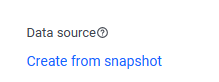
- In the "Select Snapshot" panel that appears, select the desired encrypted snapshot and click "OK".
- Configure other parameters based on your needs. For descriptions of volume parameters, see Creating a volume.
Verifying that a volume is encrypted
warning
This method verifies encryption by disabling keys, which can result in read/write errors on the system volume. We recommend using a test instance for testing purposes.
- When creating an ECS test instance, use a system volume that is encrypted with a customer master key.
- Disable the customer master key.
- In the KMS console, on the customer master key page, select the region where your key is located.
- On the "customer master key" page, find your key and click "detail" in the "operation" column.
- On the "Key Ring Details" page, disable the key by toggling off the switch in the "state" column. In the box that appears, click "OK".
- Verify that the volume is encrypted.
- After disabling the KMS key, you can verify that the volume is encrypted by looking for the following behaviors:
- You cannot stop, restart, or delete the instance in the console.
- After the volume is detached, it cannot be reattached.
- For one week after the key is disabled, you can continue to read and write data to the volume. After more than a week, however, you will no longer be able to perform any read or write operations on the volume.
- Re‑enable the KMS key and release the test instance.
Billing notes
Volume costs
The billing rules for encrypted and non-encrypted volumes are the same, and using the encryption feature does not incur additional fees. For more information, see Volume billing.
Key charges
- Customer master key (CMK): If you choose to use your own CMK for encryption, KMS will charge you separately for the related key management and invocation fees.
- Service key: There are no additional charges for using the default service key for encryption.
Quotas and limits
Instance type
Only third-generation and later instances are supported when you encrypt a system volume or create an encrypted data volume from a snapshot.
Volume type
Only ESSD PL0 and ESSD FlexPL volumes are supported when you encrypt a system volume or create an encrypted data volume from a snapshot.
Changing the encryption type
You cannot directly change the encryption type of an existing volume. However, you can achieve this indirectly by selecting a new KMS key when creating a new volume from a snapshot of the original.
Last updated: 2026.06.03 17:05:25
All rights reserved © Beijing Volcano Engine Technology Co., Ltd2024
