Torch Log Service
Torch Log Service
Torch Log Service


Document
Product News
Product Overview
Product Billing
User Guide
TLS Agent
AgentLoop
Resource management
Host group
Data collection
LogCollector collection
Introduction to LogCollector
Installation and upgrade
Collect host logs
Collect container logs
LogCollector plugins
Manage LogCollector
general reference
Data import
Cloud product log collection
TOS log collection
DBW log collection
VPN Log collection
VKE log collection
CLB log collection
CloudTrail log collection
CFW log collection
NTA log collection
ALB log collection
APMPlus log collection
veFaaS log collection
VPC log collection
veImageX log collection
TrafficRoute DNS log collection
DDoS log collection
WAF log collection
DCDN log collection
Multi-cloud security platform log collection
APIG log collection
Machine learning task log collection
CR log collection
Volcano Ark application lab log collection
FileNAS log collection
LLM Application Firewall Service log collection
vePFS log collection
Cloud security center log collection
EFS log collection
Data storage
Query and analysis
Configure log indexes
Query log
Analyze logs
Query and analyze logs using third-party tools
Associate external data source for log query
SQL function
SQL syntax
Visualization
Query and analysis charts
Summaries of query and analysis charts
Create dashboard
Use dashboard
Add dashboard filters and variables
Use other systems to analyze logs
Log application
Log applications for product observability
Log applications for large models observability
Coding Agent log app
ModelProvider log app
No-coding Agent log app
Log applications for basic service monitoring
Data processing
Data transformation
Syntax and functions
Global operation function
expression function
Data processing best practices
general reference
Data write processor
Data consumer processor
Data consumption and shipping
Ship logs to TOS
Ship logs to Kafka
Ship logs to Splunk
Alarm
Alarm policy
Alarm notification content
Alarm notification content template
alarm notification channel
Tracing service
Monitor Log Service
API reference
Project management API
Topic management API
Shard management API
Index management API
Log management API
Host group management API
Collection configuration management API
Data import API
Data processor API
Data transformation API
Data backflow API
SQL analysis API
Alarm management API
Consumer group management API
Kafka protocol consumption API
Tag management API
Trace storage API
Account management API
SDK reference
Go SDK
Java SDK
Python SDK
iOS SDK
C++ SDK
CLI reference
Best practices
Data collection
Query and analysis
permission management
Consumption and delivery
Visualization
Alarm
FAQs
Billing and cost FAQ
Data collection FAQ
Data storage FAQ
Index configuration FAQ
Query and analysis FAQ
Scheduled SQL tasks FAQ
Alarm FAQ
- Documentation
 Torch Log ServiceUser GuideData storageStorage types
 Copy page
 Download PDF
Data storage
Storage types
Copy pageDownload PDFStorage types
Through different storage types, TLS provides data tiered storage feature, suitable for storing log data with varying access frequencies. This topic introduces TLS storage types and applicable scenarios.
Storage types
TLS supports the following storage types:
Storage types | Conditions | Description |
Storage types | Conditions | Description |
Standard storage | None | Standard storage is a general storage solution provided by TLS. By default, log data is saved in TLS using standard storage. Standard storage offers high performance and high throughput capacity. It is suitable for storing frequently accessed log data, such as logs that require frequent query and analysis. Standard storage has the following features:
|
Infrequent access storage (IAS) | The standard storage period is 7 days or longer. | IAS storage is a cost-effective long-term storage solution. It supports log query and analysis, visualization, data processing, delivery, and consumption, with slightly lower reading performance compared to standard storage. It is suitable for storing logs accessed infrequently, such as logs that are not regularly queried or analyzed. IAS storage has the following features:
|
Archive storage | Meet any of the following conditions:
| Archive storage builds upon standard storage or IAS storage; provides a lower-cost solution for long-term data retention. Archive storage offers query and analysis capabilities at the minute level, suitable for data audit scenarios. Archive storage has the following features:
|
Types comparison
Description
When the range for query and analysis includes standard storage, IAS storage, and archive storage, the concurrency operations for archive storage take precedence.
Storage types | | Standard storage | Infrequent access storage | Archive storage |
Storage types | | Standard storage | Infrequent access storage | Archive storage |
Use cases | |
|
|
|
Costs | | 0.0115 CNY/GB/day | 0.005 CNY/GB/day | 0.0025 CNY/GB/day |
Performance | Latency (billions of records) | Millisecond-level query | Query by second | Query by minute |
| Operation concurrency |
| Concurrent sessions per project
| Concurrent sessions per project
|
Conditions | | None | Standard storage duration is 7 days or longer. | Meet any of the following conditions:
|
Minimum storage duration | | The minimum storage duration for standard storage is 1 day. | The minimum storage duration for IAS storage is 1 day. | The minimum storage duration for archive storage is 60 days. |
Features comparison
Feature | Standard Storage | Infrequent Access Storage | Archive Storage |
Feature | Standard Storage | Infrequent Access Storage | Archive Storage |
Query | ✓ | ✓ | ✓ |
Analysis | ✓ | ✓ | ✓ |
Context query | ✓ | ✓ | ✓ |
Rebuild index | ✓ | ✓ | × |
Dashboard | ✓ | ✓ | × |
Data transformation | ✓ | ✓ | × |
Data consumption | ✓ | ✓ | × |
Log shipping | ✓ | ✓ | × |
Alert | ✓ | ✓ | × |
SQL analysis | ✓ | ✓ | × |
Set storage types
You can set storage type of log data in TLS. When you create or edit topics, enable the Log storage time configuration feature and then you can set storage types. For details, see Log topic.
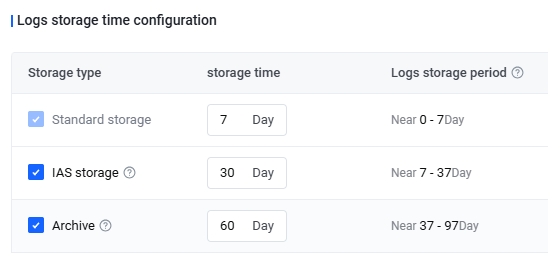
- Standard storage
- Standard storage is required to be enabled.
- Infrequent access storage (IAS)
- If IAS storage is enabled, log data will be stored in standard tier for a period of time before they are automatically converted to IAS storage. This means you need to set storage period for log data in standard tier, and this period should be no less than 7 days. If log data is stored longer than the period, data will be automatically sent to the IAS storage tier. Data will be retained there until its storage period expires and is automatically deleted.
- Archive storage
- If only archive storage is enabled and IAS storage is not enabled, log data will be kept in the standard storage tier for a set period before it is automatically transferred to archive storage. This means you need to set the storage time for log data in the standard storage tier, and this time must be no less than 30 days. If log data is stored longer than the period, data will be automatically sent to archive storage tier. Data will be retained there until its storage period expires and is automatically deleted.
- When both IAS storage and archive storage are enabled, log data will be kept in the standard storage tier for a period, and then automatically sent to IAS storage. After the storage time in IAS storage expires, it will be sent to archive storage. This means you need to first set the storage period for log data in the standard storage tier. This period should be no less than 7 days. Then, set the storage period for log data in the infrequent access tier. This period should be no less than 30 days. If log data is stored longer than the period, log data will automatically move down through the storage tiers for further preservation, and will be automatically deleted when the storage time expires.
Last updated: 2026.07.30 17:29:25
All rights reserved © Beijing Volcano Engine Technology Co., Ltd2024
