Torch Object Storage
Torch Object Storage
Torch Object Storage


Document
What's New
Announcements
Billing
Billable items
Billing method
Getting Started
User Guide
Working with buckets
Basic configurations
Managing lifecycle
Back-to-origin rules
Event notification
Intelligent Tiering
Permissions
Domain management
Fault tolerance and disaster recovery
Cross-region replication
Same-region replication
Data redundancy
Image processing
ObjectSet
Working with objects
Managing folders
Monitoring and alerting
Metric monitoring
Access control
Bucket policies
Common configuration scenarios
Authorizing IAM users of the current account
Authorizing other accounts
Managing access via tools and SDKs
Managing public read access
Data security
Access points
Multi-region access points (MRAP)
Single-region access points (SRAP)
Converged access points (CAP)
DevMind
TOS accelerator
SenseFlow
TOS Agent
Data processing
Basic concepts
Image processing
Media processing
Document preview
Task processing
Data subscription
Flow control management
Quality of Service (QoS) policies
Hierarchical namespace (HNS)
User guide
Tool reference
Best practices
TOS Vectors
User guide
API reference
Vector bucket
Vector index
SDK reference
Python-Vectors
Vector bucket
Vector index
Java-Vectors
Vector bucket
Vector index
Node.js-Vectors
Vector bucket
Vector index
Tool Guide
tosutil
Common commands
Upload, download, and copy objects
Share objects
Auxiliary commands
Common examples
TOS Browser
FSX
FSX best practices
TOS PyTorch Connector
tosfsspec
API Reference
Signature Mechanism
The header contains a signature
Bucket
Basic Bucket Operations
Bucket Lifecycle
Access Monitor
Bucket ACL
Bucket CORS
Bucket Policy
Back-to-origin Rules
Bucket Replication
Versioning
Static Website
Event Notification
Custom Domain
Server-side encryption
Transfer Acceleration
Data Processing
Image processing
Media processing
Video transcoding
Audio transcoding
video to GIF
Document preview
File decompression
Log Storage
Retention Policy
Requester pays
TLS version
Object
Basic Object Operations
Object ACL
Fetch Object
Symbolic Link
WORM object
Multipart Upload
SDK Reference
Java
Pre-signing Mechanism
Bucket Interface
Basic Bucket Interface
Manage Bucket Configuration
Object Interface
Upload Object
Download Object
Upload and Download Speed Limit
Copy Object
List Object
Data Processing
Image Processing
Video Processing
Audio Processing
Log Configuration
Hierarchical Namespace
Bucket base interface
Introduction to Typical Scenes
Python
Data processing
Pre-signature mechanism
Bucket interface
Basic bucket interface
Manage bucket configuration
Object interface
Upload object
Download object
Copy object
List objects
Introduction to typical scenes
C
Object Interface
Upload object
C++
Pre-signature Mechanism
Bucket Interface
Basic Bucket Interface
Manage Bucket Configuration
Object Interface
Upload Object
Download Object
Copy Object
List Objects
Data Processing
Go
Object Interface
Upload Object
Download Object
Copy Object
List Objects
Manage Objects
Bucket Interface
Manage Bucket Configuration
Data Processing
Log Configuration
Introduction to Typical Scenes
Pre-signature Mechanism
Node.js
Pre-signature Mechanism
Bucket Interface
Basic Bucket Interface
Manage Bucket Configuration
Object Interface
Upload object
Download object
Copy object
List objects
Data Processing
Image Processing
Introduction to Typical Scenes
Browser.js
Pre-signature Mechanism
Upload Object
Download Object
Copy Object
List Objects
Manage Objects
Data Processing
.NET
Bucket Interface
Object Interface
Upload Object
Download Object
List Objects
Introduction to Typical Scenes
PHP
Bucket Interface
Object Interface
Download Object
Data Processing
Exception Handling
Android
Bucket Interface
Object Interface
Upload Object
Download Object
Exception Handling
iOS
Bucket Interface
Object Interface
Upload Object
Download Object
Harmony
Pre-signature Mechanism
Bucket Interface
Object Interface
Upload Object
Download Object
List Objects v2
Introduction to Typical Scenarios
Rust
Pre-signing mechanism
Bucket interface
Basic bucket operations
Lifecycle rules
Bucket ACLs
Cross-origin resource sharing
Bucket inventory
Back-to-origin rules
Bucket replication
Static website hosting
Event notification
Custom domain
Server-side encryption
Object interface
Basic operation
Access control
Error Codes
01-SERVICE_ERROR
02-AUTH
03-ACCESS_CONTROL
04-QOS
05-REQUEST
06-BUCKET
07-LIFECYCLE
08-ACL
09-CORS
10-POLICY
11-MIRROR
12-REPLICATION
13-WEBSITE
14-NOTIFICATION
15-ENCRYPT
16-CUSTOMDOMAIN
17-OBJECT
18-TAG
19-MULTIPART
20-STORAGE_CLASS
21-CALLBACK
22-DATA_PROCESS
23-BATCH
24-STORAGE_LENS
25-INVENTORY
26-DIRECTORY_BUCKET
FAQ
Best Practices
AIGC-Doubao LLMs
Accessing TOS with third-party tools
Granting temporary access
Data migration
Data processing
Checking data integrity
Performance optimization
- Documentation
 Torch Object StorageTOS VectorsOverview
 Copy page
 Download PDF
TOS Vectors
Overview
Copy pageDownload PDFOverview
TOS Vectors is a new storage service designed for the AI-native era. With TOS Vectors, you can easily store, query, and manage vector data. Its semantic understanding and similarity search features transform traditional object storage, elevating it from merely "saving data" to actively "understanding data". Leveraging TOS's high reliability and elastic scalability, TOS Vectors offers a cost-effective vector storage for applications such as intelligent search, retrieval-augmented generation (RAG), and AI agents.
Core concepts
TOS Vectors consists of the following key components that work together:
- Vector buckets: A new type of bucket designed for storing and querying vectors.
- Vector indexes: You can organize your vector data within a vector bucket using vector indexes. You can also perform similarity queries on your vector data within vector indexes.
- Vectors: The fundamental elements stored in a vector bucket. They are arrays of floating-point numbers that represent the semantic relationships between text, images, and audio. Similarity searches are performed based on semantic meaning during queries. You can also attach metadata to vectors to filter query results based on conditions such as timestamps and types.
Benefits
- New architecture: TOS Vectors is built on a serverless architecture. This architecture addresses the high costs and poor scalability of traditional storage-compute architectures when handling massive amounts of infrequently accessed AI data.
- Extremely low cost: TOS Vectors employs a simple, transparent billing model. It only charges for uploaded data, used storage capacity, and scanned data during retrieval. This significantly reduces the high computing and maintenance costs associated with traditional databases or standalone retrieval systems, cutting the total cost of storing vectors by over 90%.
- Infinite elasticity: TOS Vectors uses a distributed system to store and manage large-scale vector data. Its serverless elastic scaling automatically adjusts the system based on load, ensuring high availability and performance.
- Native support for semantic search: With TOS Vectors, you can query vector data within an index to get similarity-based results. You can filter based on scalar metadata to refine your results precisely. TOS Vectors also supports defining non-filterable metadata, which can be returned alongside search results to provide more detailed information.
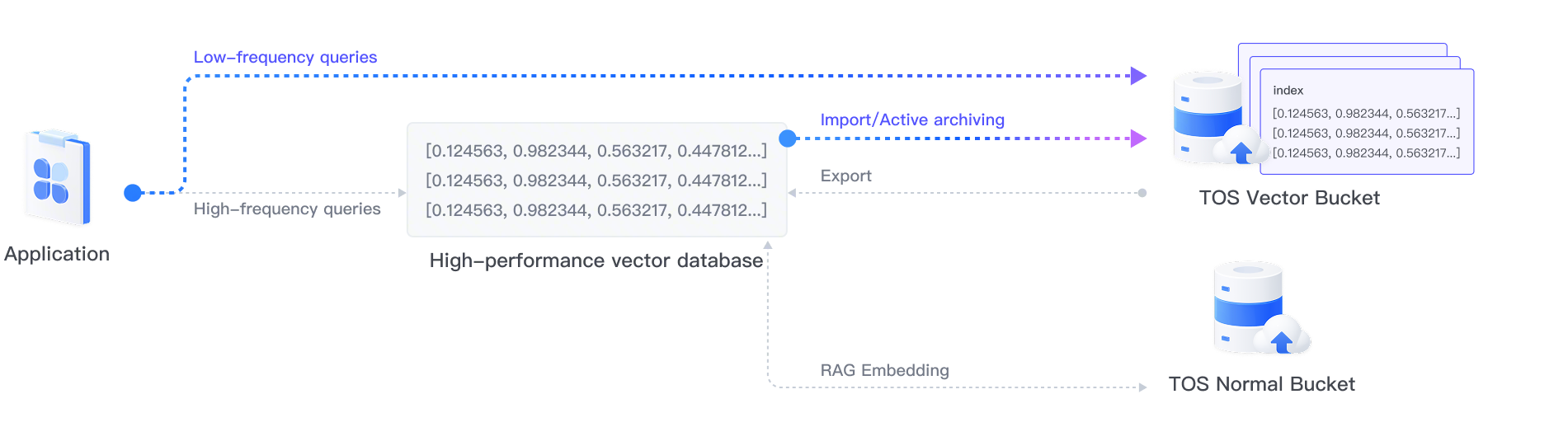
- Tiered storage: Use TOS Vectors for the long-term, low-cost storage of cold vector data. Use high-performance vector databases, such as VikingDB and Volcano Engine Cloud Search, for hot data. This combination enables tiered storage and on-demand scheduling of hot and cold data, effectively balancing speed, cost, and memory depth.
- Easy to use: TOS Vectors provides developers with a dedicated set of APIs and SDKs, enabling tasks such as automation and visualization. Common management operations such as search queries, writing vector data, and batch insertion can be easily performed through the TOS console.
Use cases
Building low-cost RAG applications and knowledge bases
AI business development leads to explosive growth in vector data, which greatly increases storage and retrieval costs. TOS vector buckets provide an affordable foundation for RAG applications with higher tolerance for retrieval latency, including knowledge Q&A, intelligent customer service, and medical image retrieval.
Building AI agents with tiered retrieval
Different AI agents have different performance requirements for retrieval. All vector data can be stored centrally in ultra-low-cost TOS vector buckets for long-term or infrequently accessed memory. For business scenarios requiring high performance and low latency, hot data can be synchronized with a high-performance vector database. This creates an agent application architecture with tiered retrieval.
Building a unified AI content management platform
AI applications generate massive amounts of unstructured content (raw data) and vectorized results (vector data). This can easily lead to fragmented storage and retrieval systems. Storing raw data in TOS standard buckets and vector data in TOS vector buckets allows for the use of a single set of APIs/SDKs to manage and access both the original files and the vector indexes. This setup is ideal for efficient, unified AI content management.
Features
Vector management
- Creating vector buckets and indexes.
- Writing and deleting vectors in vector indexes.
- Adding metadata to vectors.
- Vector retrieval and recall (e.g., using cosine similarity or Euclidean distance), and metadata filtering.
Dedicated endpoints
Dedicated public and private network access domains, isolated from standard TOS buckets.
Secure transmission
Encrypted transmission via HTTPS to ensure data security during transfer.
Access control
Resource-based policies (e.g., bucket policies) to precisely control access at the vector bucket or single/multiple vector index level.
How it works
The following diagram illustrates how TOS Vectors works.
Constraints and limitations
Category | Description |
Category | Description |
Vector buckets | Each account can have up to 100 vector buckets per region. |
Vector indexes | During the closed beta period, each vector bucket can hold up to 100 vector indexes. |
Vectors | Each vector index can store up to 50 million vectors. |
Retrieval performance | 200 QPS. |
Recall rate | 90%. |
Average retrieval latency | 500 ms. |
Billing notes
This feature is currently in a free closed beta and is only available in China (Beijing). Contact your account manager to request a trial.
Last updated: 2026.04.16 16:19:28
All rights reserved © Beijing Volcano Engine Technology Co., Ltd2024
