Elastic Compute Service
Elastic Compute Service
Elastic Compute Service


Document
Elastic Compute Service
What's New
Announcement
OpenAPI related
Pricing and quotas are related
About products and plugins
Feature discontinuation
Overview
Billing
Billable items
Billing methods
Billing methods change
Getting Started
User Guide
Instances
Instance types
X86 Computing
Elastic Bare Metal Server
Heterogeneous Computing
Select instance billing method
Spot instance
Elastic Scheduled Instance
Offsetting Resources
Reserved Instances
Buying ECS instances
Logging in to an instance
Logging in to a Linux instance
Managing instance status
Modifying instance types
Using instance user data and metadata
Instance metadata
Images
Public images
veLinux images
Custom images
Importing custom images
Creating custom images
Image detection
End of life (EOL) of image
Elastic Block Storage
Basic volume operations
Partitioning and formatting a volume
Extending a volume
EBS Agent
Snapshots
Basic snapshot operations
Auto snapshot policies
DataInsights
Network
Network interface and IP address
IP Address
IPv4 address
Security group
Security
Passwords and key pairs
Deployment and scaling
Monitoring
Monitoring metrics
Event monitoring
Local volume event O&M
Method 1: Solve the local volume failure by replacing the faulty volume
O&M
Cloud assistant
Managing agents
Process choreography
Common operation and maintenance tasks
Batch operations on instances
Batch operations on EBS Volumes
Batch operations on images
Temporary upgrade of bandwidth
Managing application updates
orchestration plan
Patch management
Managing patch plans
Managing patch baselines
IAM
Tags and projects
Best Practices
AI applications
OpenClaw (formerly Moltbot)
Quickly deploying OpenClaw via application templates
Quickly deploying OpenClaw via marketplace images
Manually deploying OpenClaw
Self-service website creation
Building environments
Building a Web environment (Windows)
Building applications
Building FTP site
Deploying databases
Building game servers
Building websites
Building a WordPress blog
Building multiple websites
Manage software sources for Linux instances
AIGC practices
Performance test
Network performance test
Instance configuration
Setting up AD Domain Services on Windows OS
Windows Multi - User Login
Changing screen resolution
Instance data
Uploading or downloading files
Data restoration
ECS instance local time synchronization
Volume
Monitoring
Security
Images
Kernel fine-tuning
O&M
Troubleshooting
Remote log in issue
Linux operating system issue
Windows operating system issue
SSH log in issue
Operating system issue
veLinux operating system issue
Linux operating system issue
Windows operating system issue
Instance status issue
Instance unable to start issue
High instance load issue
GPU instances issue
Network connection issue
Network configuration issue
Storage classes issue
EBS Volume issue
Local Disk issue
Logs and monitoring issue
Third - party software issue
API Reference
Regions and availability zones
Instances
Images
HPC clusters
Key pairs
Tags
Volumes
Reserved storage capacity
Snapshot
Auto snapshot policy
Monitoring
Deployment sets
Launch templates
Cloud assistant
Patch management
SDK reference
CLI Reference
FAQ
Dedicated Host DDH
What's New
Billing
User Guide
Manage Dedicated Host
Manage Dedicated Host Cluster
Manage ECS instances
Monitoring and O&M
API reference
proprietary host
- Documentation
 Elastic Compute ServiceElastic Compute ServiceUser GuideSnapshotsHow snapshots work
 Copy page
 Download PDF
Snapshots
How snapshots work
Copy pageDownload PDFHow snapshots work
A snapshot is a backup of a volume taken at a specific point in time. This topic explains how snapshots work, including incremental snapshots, rollback, and deletion.
Incremental snapshots
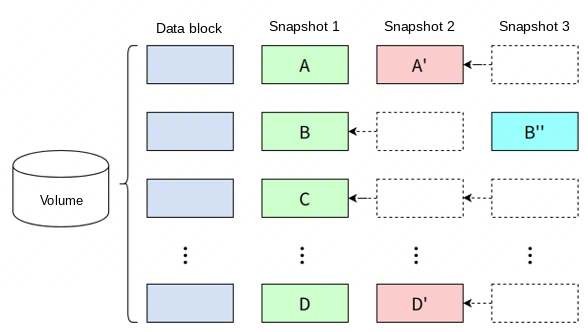
Snapshots use an incremental approach to save storage space and costs. The first snapshot you create for a volume is a full snapshot. Subsequent snapshots are incremental, meaning they only capture data that has changed since the last one.
As shown in the diagram below, snapshots 1, 2, and 3 represent three different points in time of a volume.
- Snapshot 1 is the first snapshot of the volume. It backs up all the volume's data blocks.
- Snapshot 2 is the second snapshot of the volume. It only backs up the changed blocks (A' and D'). Blocks B and C reference data from snapshot 1.
- Snapshot 3 is the third snapshot of the volume. It backs up only the changed block (B''). Blocks A' and D' reference data from snapshot 2, and block C references data from snapshot 1.
-
Rolling back a volume
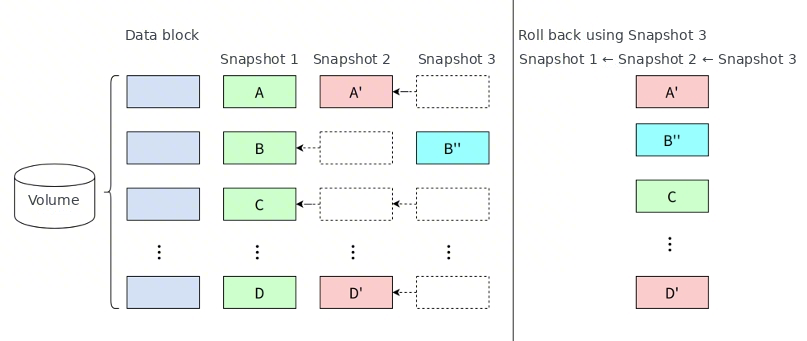
When you roll back a volume using a specific snapshot, EBS automatically merges it with the previous ones. If there are identical data blocks, the system retains the data from the most recent snapshot. During the rollback process, EBS writes the merged data to the volume.
As shown in the diagram below, snapshots 1, 2, and 3 represent three different points in time of a volume. When you roll back using snapshot 3, the system restores the volume to the state of the data captured in that snapshot, which consists of blocks A', B'', C, and D'.
Deleting snapshots
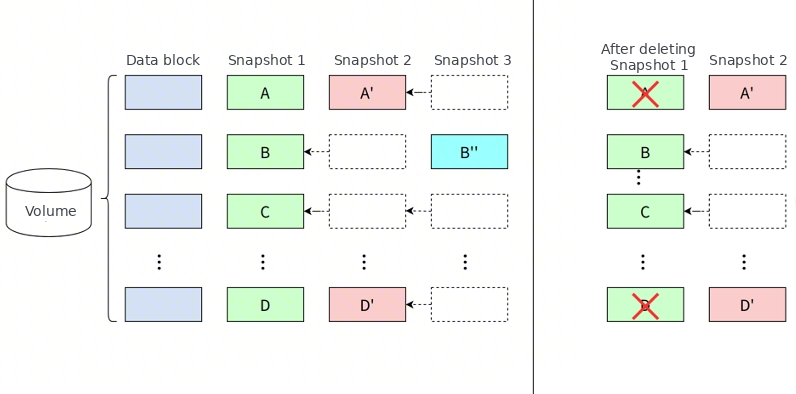
You can delete some of your snapshots to free up space if you no longer need to keep them or if you have more than the limit allows.
As shown in the diagram below, snapshots 1, 2, and 3 represent three different points in time of a volume. Deleting snapshot 1 will delete blocks A and D, which contain new data, while blocks B and C, which are still referenced, will be retained.
Last updated: 2026.05.15 15:10:44
All rights reserved © Beijing Volcano Engine Technology Co., Ltd2024
