Volcengine Kubernetes Engine
Volcengine Kubernetes Engine
Volcengine Kubernetes Engine


Document
Volcengine Kubernetes Engine
What's New
History feature release notes
Kubernetes version release notes
Containerd runtime release notes
Add-on release notes
Monitoring add-ons
Scheduling add-ons
DNS add-ons
Security add-ons
GPU add-ons
Sandbox add-on
Security announcements
Product Announcement
Historical announcements
Overview
Getting started
User guide
Clusters
Creating clusters
Connecting to clusters
Upgrading clusters
Node pool
Creating node pools
Scaling out/in node pools
Nodes
Authorization management
Image
Namespaces
Networking
Cluster network
Container Network
Service
LoadBalancer
CLB
Ingress
APIG Ingress
ALB Ingress
Customize ALB Ingress forwarding rules
Certificate and security
CLB Ingress
Nginx Ingress
Gateway API
Workloads
Creating workloads
Configure workloads
Pods
Configuration management
Image acceleration
Storage
FSX client
EBS Volumes
TOS Volumes
NAS volumes
FSX access methods
NFS access methods
EFS volumes
vePFS volumes
FSX access methods
vePFS Client access methods
NFS access methods
CloudFS volumes
Local volumes
Autoscale
Node autoscaler
Workload autoscaler
Horizontal Pod Autoscaler (HPA)
Cron Horizontal Pod Autoscaler (CronHPA)
Intelligent Horizontal Pod Autoscaler (IHPA)
Horizontal Pod Autoscaler based on event-driven (KEDA)
Add-on management
Network add-ons
Storage add-ons
Monitoring add-ons
Scheduling add-ons
DNS add-ons
GPU add-ons
Core add-ons
Sandbox add-on
Upgrading add-ons
Heterogeneous computing
NVIDIA GPU
mGPU scheduling
RDMA high-performance computing
Scheduling management
Topology-aware scheduling
QoS-aware scheduling
Observability
Log management
Basic observation
Setup & Configuration
Cluster observation
Storage observation
Other observation
Using metrics
Full stack observation
Alert management
Diagnosis and inspection
Node check and self-healing
Application center
Backup center
Stability
Large-scale cluster management
Best practices
Authorization
Clusters
Nodes and node pools
Networking
Storage
Scheduling
Observability
Solution
Security and compliance
API reference
Cluster management
NodePool management
Node management
Virtual nodes management
Add-on management
Tag management
Access policy management
Instance images management
Cloud native observability
Inspection and diagnosis
Task management
Volcengine Container Instance
Appendix
SDK reference
Development guide
Terraform
FAQs
General FAQs
Cluster FAQ
cluster management
cluster network
cluster upgrade
Node and Node pool FAQs
Authorization FAQs
Workload FAQs
Service and Ingress FAQs
Storage FAQs
Heterogeneous computing FAQs
Observability FAQs
Quota FAQs
Add-on FAQs
Cloud-native AI
ServingKit
LLM applications
ComfyUI application
Deploying the Al inference application through Helm
Deepseek practices
Qwen practices
Kimi practice
Seed practices
Best practices
DeepSeek model deployment
GLM model deployment
MiniMax model deployment
Qwen model deployment
Kimi model deployment
Volcengine Container Instance
What's new
Historical feature release notes
Product Announcement
Overview
Billing
User guide
Integrating with VCI
Virtual node
VKE cluster uses virtual nodes
Self-managed/third-party cluster uses virtual node
Creating an instance
General purpose instance
GPU-accelerated computing instance
VCI Agent Sandbox
Startup acceleration
E2B-based management
Upgrade guide
Networking
Monitoring
Scheduling
Container configuration
VCI Image Cache
Best practices
Security and compliance
FAQs
- Documentation
 Volcengine Kubernetes EngineVolcengine Kubernetes EngineUser guideAuthorization managementIRSA mechanismIRSA overview
 Copy page
 Download PDF
IRSA mechanism
IRSA overview
Copy pageDownload PDFIRSA overview
Volcengine Kubernetes Engine (VKE) integrates with Identity and Access Management (IAM) to provide the IAM roles for service accounts (IRSA) mechanism, which achieves fine-grained pod-level permission isolation based on VKE.
Background information
Typically, applications within a VKE cluster access other Volcano Engine cloud resources by using the following methods:
- Access the OpenAPIs of cloud resources by using the Security Token Service (STS) tokens of IAM roles, which are obtained through the metadata of the instances with which the IAM roles are associated. For details about instance metadata, see ECS instance metadata and VCI instance metadata .
tip
VKE clusters are built based on Elastic Compute Service (ECS) and Volcengine Container Instance (VCI). The metadata of ECS and VCI instances contains the basic information of the instances on the Volcano Engine cloud platform.
- Access cloud resources by using the long-term access key of a Volcano Engine IAM user or a role.
Both access methods may bring high security risks and make it difficult to isolate permissions based on different applications in a cluster. Therefore, the IRSA solution is provided by VKE to help you associate IAM roles with applications at the pod level in a cluster.
Feature introduction
IRSA is a security mechanism that allows applications in a VKE cluster to use Volcano Engine IAM roles through Kubernetes service accounts. The IRSA mechanism associates a specific IAM role with a service account. This enables pods running in a VKE cluster to obtain the permissions granted to the role through the service account. In this way, the pods can access corresponding cloud service resources.
The following figure shows the workflow of the IRSA feature.
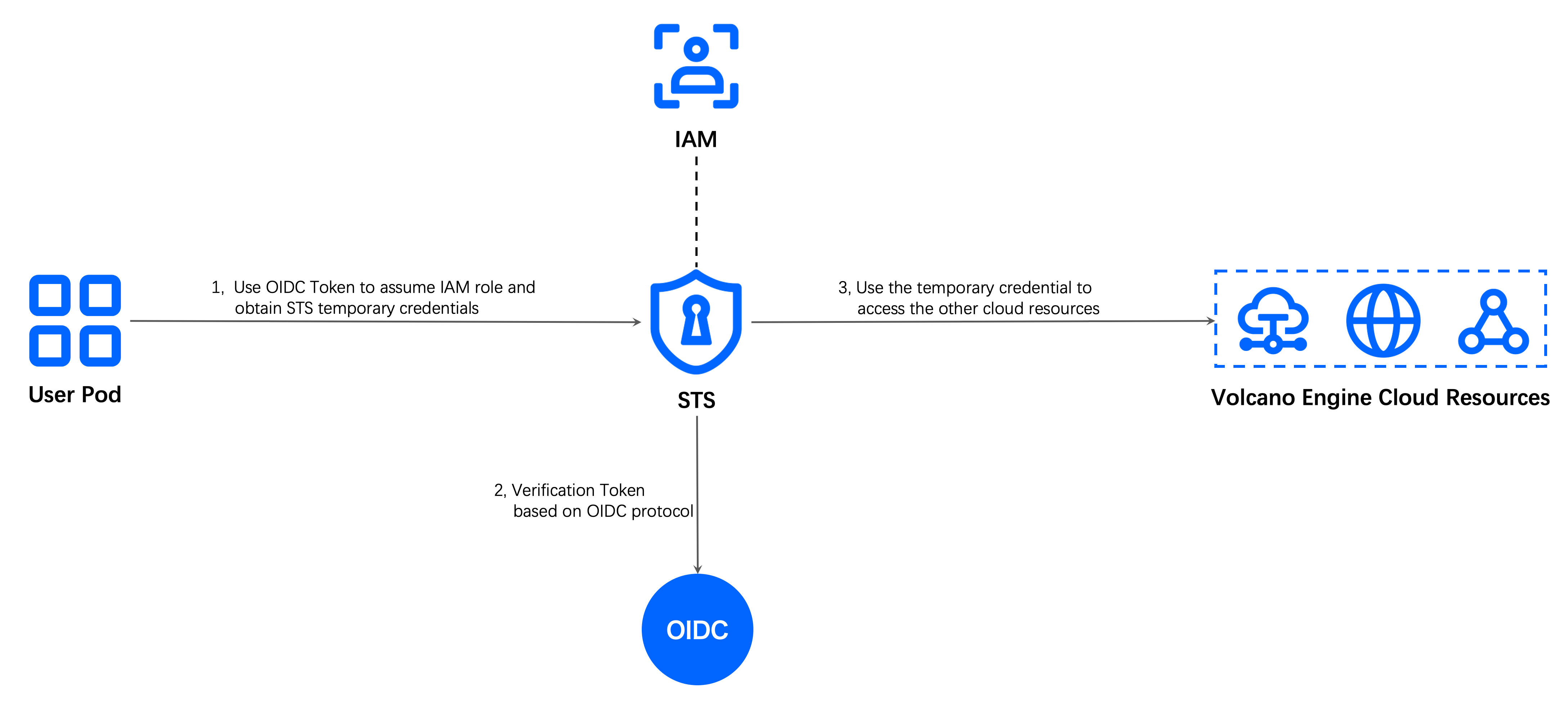
- A client launches a pod using service account token projection. For details, see Configure Service Accounts for Pods.
- The cluster API server issues an OIDC token for the pod, which is generated based on the OIDC identity, and then the kubelet mounts the token for the pod and refreshes it regularly.
- The program running in the pod accesses the AssumeRoleWithOIDC API of STS by using the mounted OIDC token file to obtain a temporary credential for the specified IAM role.
- The program running in the pod uses temporary credentials to access the OpenAPIs of other cloud resources on Volcano Engine.
Feature advantages
Key advantages of the IRSA mechanism:
- Principle of least privilege: Assign a specific IAM role to each service account. This enables fine-grained permission management for services. It ensures services only access necessary resources, enhancing business security and conforming to the principle of least privilege.
- Security: IRSA minimizes the requirements for hard-coding access credentials in application code or container images, which reduces potential security risks.
- Easy management : Kubernetes service accounts enable simplified, centralized, and unified permission management for cloud resource access.
Last updated: 2026.06.12 11:25:11
All rights reserved © Beijing Volcano Engine Technology Co., Ltd2024
