Volcengine Kubernetes Engine
Volcengine Kubernetes Engine


Document

- Documentation
 Volcengine Kubernetes EngineVolcengine Container InstanceSecurity and complianceShared security responsibility for VCI
 Copy page
 Download PDF
Security and compliance
Shared security responsibility for VCI
Copy pageDownload PDFShared security responsibility for VCI
This topic introduces the shared security responsibility model for VCI.
Compared with traditional on-premises data centers, cloud computing separates service operators from customers, offering greater flexibility and control while effectively reducing operational burdens on customers. Therefore, cloud computing security cannot be fully borne by a single party. Cloud security requires joint efforts from Volcano Engine and you.
Security responsibility division
Volcano Engine security responsibilities
Volcano Engine VCI maintains the security and reliability of the Serverless platform. Its core responsibilities include:
- Ensuring platform infrastructure security
- Providing secure data storage and processing services
- Protecting customer data confidentiality
Volcano Engine ensures compliance of its infrastructure, management, and security practices. This protects your applications from attacks and safeguards your data's privacy and integrity.
Your security responsibilities
You, as a customer of Volcano Engine, are responsible for the security of your Serverless applications throughout the entire lifecycle. This involves a wide range of factors, such as application and data security, access control, code development audits, authentication and authorization rule configuration, and permission assignment only to authorized individuals or teams. The core responsibilities are as follows:
- Responsibility for self-introduced security risks: You are fully responsible for application failures and security issues caused by operations such as deploying Pods with security vulnerabilities or configuring over-privileged authorization policies.
- Responsibility for risks from actively applied container privileges: Volcano Engine disables privileged features such as Capabilities by default, as they may affect container stability and security. If you enable these privileges by actively applying for them, you are responsible for stability issues and container security risks (such as lateral attacks on other Pods within the cluster) caused by improper privilege configurations.
Security responsibility for jointly managed resources
One-party management models like full hosting cannot be applied to some Volcano Engine resources (such as pod security groups) due to customer requirements for autonomous management and refined control. Therefore, the following principles for defining mutual security responsibilities are established:
- The party introducing risks shall bear responsibility. You are solely responsible for failures and losses caused by autonomous operations, such as creating pods with security vulnerabilities or using malicious images. Volcano Engine ensures that VCI pods are free of security risks and do not affect the normal operation of your applications.
- Both parties adhere to the principle of least privilege. You are responsible for security attacks and their consequences caused by situations such as overly broad public network access scope. Volcano Engine ensures that pod security groups within the VCI scope follow least privilege configuration, will not expand access scope beyond authorized limits, and will prevent container escape.
Cloud security requires clear responsibility boundaries between you and Volcano Engine, as well as close cooperation between both parties: Volcano Engine is responsible for cloud infrastructure security and compliance assurance, while you are responsible for the security of your own applications and data. For areas with overlapping responsibilities, Volcano Engine will take the initiative to prevent and control risks, eliminate risk blind spots, and provide more secure Serverless services.
Understanding the shared responsibility model
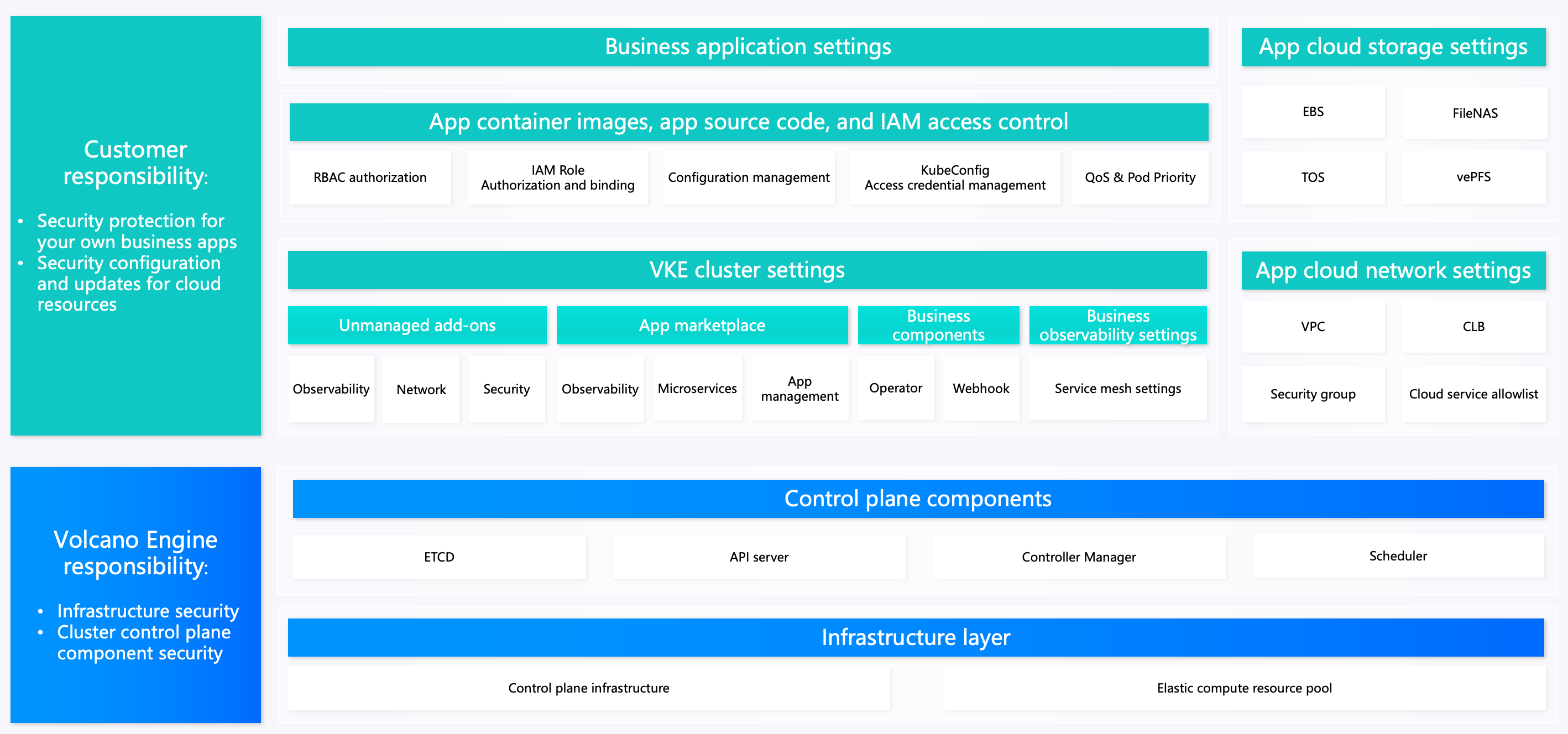
Before designing and deploying enterprise application systems, understand the security responsibility boundaries between you and Volcano Engine. For VCI, Volcano Engine manages the infrastructure and also ensures the security of pod runtime environments and related runtime components. The figure below shows the responsibility boundaries between Volcano Engine and customers (you) in scenarios of using VCI in a Serverless architecture.
Volcano Engine responsibilities
On the control plane, Volcano Engine implements security hardening for VCI control plane components based on industry-wide security standards such as the Kubernetes security baseline. It also builds and provides standardized security system support for typical scenarios of full-lifecycle security protection for enterprise cloud-native applications. Specific responsibilities are as follows:
Security category | Details |
Infrastructure security |
|
Security of elastic computing resource pools | Adopt lightweight virtual machine isolation technology for container operating systems to implement secure isolation of underlying resources. |
Security of cluster management and management components | Ensure security for core management capabilities, including cluster authentication and certificate management, in-cluster Secret management, compliance control of externally exposed ports, VPC isolation, and security group configuration validation. |
Security of unmanaged add-ons and application marketplace Charts | Provide standardized core configurations to mitigate basic security issues at the baseline configuration level, ensuring the initial security baseline of unmanaged add-ons and marketplace Charts. |
Your responsibilities
On the data plane, your security operation and maintenance (O&M) team is responsible for the security protection of business applications deployed on the cloud, as well as the secure configuration and dynamic update of cloud resources. You need to fulfill security responsibilities for data plane processes. Specific responsibilities are as follows:
Security category | Detail |
Application security |
|
O&M security | Ensure security compliance of network configuration, storage configuration, and business observability configuration for your cloud applications, eliminating security vulnerabilities throughout the entire O&M process. |
Security of business components | Impose strict restrictions on the operational logic of business components, such as Operators and Webhooks, and prevent abnormal component behaviors that affect the secure operation of other applications. |
Security of unmanaged add-ons and application marketplace Charts |
|
Related documentation
Last updated: 2026.07.24 16:18:06
All rights reserved © Beijing Volcano Engine Technology Co., Ltd2024
