Volcengine Kubernetes Engine
Volcengine Kubernetes Engine
Volcengine Kubernetes Engine


Document
Volcengine Kubernetes Engine
What's New
History feature release notes
Kubernetes version release notes
Containerd runtime release notes
Add-on release notes
Monitoring add-ons
Scheduling add-ons
DNS add-ons
Security add-ons
GPU add-ons
Sandbox add-on
Security announcements
Product Announcement
Historical announcements
Overview
Getting started
User guide
Clusters
Creating clusters
Connecting to clusters
Upgrading clusters
Node pool
Creating node pools
Scaling out/in node pools
Nodes
Authorization management
Image
Namespaces
Networking
Cluster network
Container Network
Service
LoadBalancer
CLB
Ingress
APIG Ingress
ALB Ingress
Customize ALB Ingress forwarding rules
Certificate and security
CLB Ingress
Nginx Ingress
Gateway API
Workloads
Creating workloads
Configure workloads
Pods
Configuration management
Image acceleration
Storage
FSX client
EBS Volumes
TOS Volumes
NAS volumes
FSX access methods
NFS access methods
EFS volumes
vePFS volumes
FSX access methods
vePFS Client access methods
NFS access methods
CloudFS volumes
Local volumes
Autoscale
Node autoscaler
Workload autoscaler
Horizontal Pod Autoscaler (HPA)
Cron Horizontal Pod Autoscaler (CronHPA)
Intelligent Horizontal Pod Autoscaler (IHPA)
Horizontal Pod Autoscaler based on event-driven (KEDA)
Add-on management
Network add-ons
Storage add-ons
Monitoring add-ons
Scheduling add-ons
DNS add-ons
GPU add-ons
Core add-ons
Sandbox add-on
Upgrading add-ons
Heterogeneous computing
NVIDIA GPU
mGPU scheduling
RDMA high-performance computing
Scheduling management
Topology-aware scheduling
QoS-aware scheduling
Observability
Log management
Basic observation
Setup & Configuration
Cluster observation
Storage observation
Other observation
Using metrics
Full stack observation
Alert management
Diagnosis and inspection
Node check and self-healing
Application center
Backup center
Stability
Large-scale cluster management
Best practices
Authorization
Clusters
Nodes and node pools
Networking
Storage
Scheduling
Observability
Solution
Security and compliance
API reference
Cluster management
NodePool management
Node management
Virtual nodes management
Add-on management
Tag management
Access policy management
Instance images management
Cloud native observability
Inspection and diagnosis
Task management
Volcengine Container Instance
Appendix
SDK reference
Development guide
Terraform
FAQs
General FAQs
Cluster FAQ
cluster management
cluster network
cluster upgrade
Node and Node pool FAQs
Authorization FAQs
Workload FAQs
Service and Ingress FAQs
Storage FAQs
Heterogeneous computing FAQs
Observability FAQs
Quota FAQs
Add-on FAQs
Cloud-native AI
ServingKit
LLM applications
ComfyUI application
Deploying the Al inference application through Helm
Deepseek practices
Qwen practices
Kimi practice
Seed practices
Best practices
DeepSeek model deployment
GLM model deployment
MiniMax model deployment
Qwen model deployment
Kimi model deployment
Volcengine Container Instance
What's new
Historical feature release notes
Product Announcement
Overview
Billing
User guide
Integrating with VCI
Virtual node
VKE cluster uses virtual nodes
Self-managed/third-party cluster uses virtual node
Creating an instance
General purpose instance
GPU-accelerated computing instance
VCI Agent Sandbox
Startup acceleration
E2B-based management
Upgrade guide
Networking
Monitoring
Scheduling
Container configuration
VCI Image Cache
Best practices
Security and compliance
FAQs
- Documentation
 Volcengine Kubernetes EngineVolcengine Kubernetes EngineUser guideNodesOverview of nodes
 Copy page
 Download PDF
Nodes
Overview of nodes
Copy pageDownload PDFOverview of nodes
Nodes are a constituent element of a cluster. A cluster consists of one or more master nodes and worker nodes. Worker nodes run the deployed applications. Applications can be deployed dynamically (randomly) or statically (fixedly) to worker nodes.
Introduction to nodes
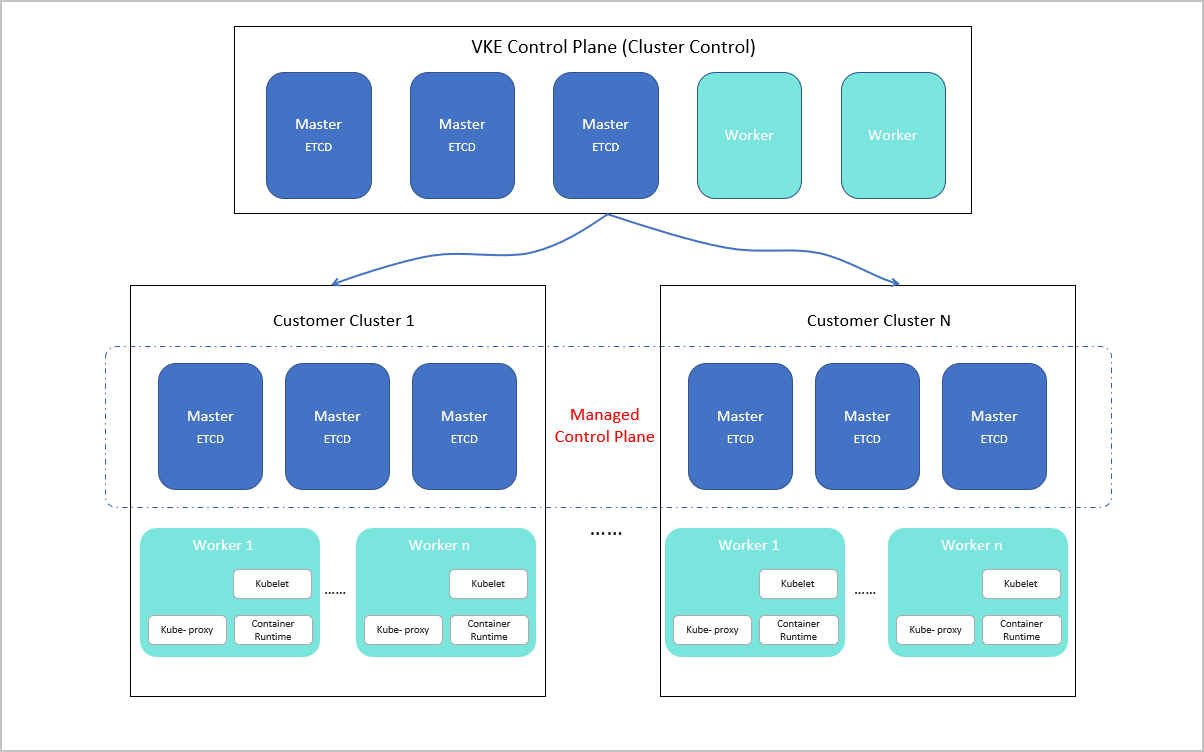
Volcengine Kubernetes Engine (VKE) provides managed clusters. The following diagram shows the architecture of a VKE cluster.
- Master nodes
- A master node is the core management unit of a cluster. VKE manages and maintains master nodes of Kubernetes clusters. You only need to purchase and deploy worker nodes to use clusters and workloads. You do not need to worry about cluster management and maintenance.
- Worker nodes
- A worker node is a cloud host or physical machine responsible for running containerized applications. A worker node consists of the following components:
- kubelet: the agent that interacts with the container runtime and communicates with the API Server to manage containers on the worker node.
- kube-proxy: a network proxy that solves access issues between applications on a worker node.
- Container runtime: a core component that is responsible for pulling container images and managing the entire lifecycle of containers. An example of a container runtime is containerd.
Node lifecycle
The lifecycle of a node refers to the various states it goes through from creation to deletion (or release). For a description of the node lifecycle and status transitions, see Resource status description.
Node specifications
Node specifications may be added or removed. Instances with a certain specification can also be sold out. We recommend that you check node specifications and instance availability on the Create node pool page of the VKE console before you plan a node pool for a cluster. For ECS specification additions, availability, and other changes, see Product announcements.
Nodes and volumes
Last updated: 2026.07.24 14:51:35
All rights reserved © Beijing Volcano Engine Technology Co., Ltd2024
