Volcengine Kubernetes Engine
Volcengine Kubernetes Engine
Volcengine Kubernetes Engine


Document
Volcengine Kubernetes Engine
What's New
History feature release notes
Kubernetes version release notes
Containerd runtime release notes
Add-on release notes
Monitoring add-ons
Scheduling add-ons
DNS add-ons
Security add-ons
GPU add-ons
Sandbox add-on
Security announcements
Product Announcement
Historical announcements
Overview
Getting started
User guide
Clusters
Creating clusters
Connecting to clusters
Upgrading clusters
Node pool
Creating node pools
Scaling out/in node pools
Nodes
Authorization management
Image
Namespaces
Networking
Cluster network
Container Network
Service
LoadBalancer
CLB
Ingress
APIG Ingress
ALB Ingress
Customize ALB Ingress forwarding rules
Certificate and security
CLB Ingress
Nginx Ingress
Gateway API
Workloads
Creating workloads
Configure workloads
Pods
Configuration management
Image acceleration
Storage
FSX client
EBS Volumes
TOS Volumes
NAS volumes
FSX access methods
NFS access methods
EFS volumes
vePFS volumes
FSX access methods
vePFS Client access methods
NFS access methods
CloudFS volumes
Local volumes
Autoscale
Node autoscaler
Workload autoscaler
Horizontal Pod Autoscaler (HPA)
Cron Horizontal Pod Autoscaler (CronHPA)
Intelligent Horizontal Pod Autoscaler (IHPA)
Horizontal Pod Autoscaler based on event-driven (KEDA)
Add-on management
Network add-ons
Storage add-ons
Monitoring add-ons
Scheduling add-ons
DNS add-ons
GPU add-ons
Core add-ons
Sandbox add-on
Upgrading add-ons
Heterogeneous computing
NVIDIA GPU
mGPU scheduling
RDMA high-performance computing
Scheduling management
Topology-aware scheduling
QoS-aware scheduling
Observability
Log management
Basic observation
Setup & Configuration
Cluster observation
Storage observation
Other observation
Using metrics
Full stack observation
Alert management
Diagnosis and inspection
Node check and self-healing
Application center
Backup center
Stability
Large-scale cluster management
Best practices
Authorization
Clusters
Nodes and node pools
Networking
Storage
Scheduling
Observability
Solution
Security and compliance
API reference
Cluster management
NodePool management
Node management
Virtual nodes management
Add-on management
Tag management
Access policy management
Instance images management
Cloud native observability
Inspection and diagnosis
Task management
Volcengine Container Instance
Appendix
SDK reference
Development guide
Terraform
FAQs
General FAQs
Cluster FAQ
cluster management
cluster network
cluster upgrade
Node and Node pool FAQs
Authorization FAQs
Workload FAQs
Service and Ingress FAQs
Storage FAQs
Heterogeneous computing FAQs
Observability FAQs
Quota FAQs
Add-on FAQs
Cloud-native AI
ServingKit
LLM applications
ComfyUI application
Deploying the Al inference application through Helm
Deepseek practices
Qwen practices
Kimi practice
Seed practices
Best practices
DeepSeek model deployment
GLM model deployment
MiniMax model deployment
Qwen model deployment
Kimi model deployment
Volcengine Container Instance
What's new
Historical feature release notes
Product Announcement
Overview
Billing
User guide
Integrating with VCI
Virtual node
VKE cluster uses virtual nodes
Self-managed/third-party cluster uses virtual node
Creating an instance
General purpose instance
GPU-accelerated computing instance
VCI Agent Sandbox
Startup acceleration
E2B-based management
Upgrade guide
Networking
Monitoring
Scheduling
Container configuration
VCI Image Cache
Best practices
Security and compliance
FAQs
- Documentation
 Volcengine Kubernetes EngineVolcengine Kubernetes EngineOverviewWhat is Volcengine Kubernetes Engine
 Copy page
 Download PDF
Overview
What is Volcengine Kubernetes Engine
Copy pageDownload PDFWhat is Volcengine Kubernetes Engine
Volcengine Kubernetes Engine (VKE) deeply integrates with the new generation of cloud-native technologies to provide high-performance Kubernetes container cluster management services with containers at their core. VKE enables you to create highly available Kubernetes clusters with a few clicks in the cloud, perform the visualized full-lifecycle management of containerized applications, and quickly create containerized applications.
Why VKE
Volcano Engine VKE, as a container cluster management service managed in the cloud, deeply integrates with high-performance computing, networking, and storage services of Volcano Engine. The computing services include Elastic Compute Service (ECS) and Elastic Bare Metal (EBM). The networking services include Virtual Private Cloud (VPC), Elastic IP Address (EIP), and Cloud Load Balancer (CLB). The storage services include Elastic Block Storage (EBS), Torch Object Storage (TOS), and FileNAS. In addition, VKE connects to multiple cloud services, such as Container Registry (CR), Code Pipeline (CP), Volcengine Managed Service for Prometheus (VMP), Torch Log Service (TLS), and Microservices Engine (MSE). This achieves an end-to-end workflow for cloud-native applications, including building, deployment, releasing, and monitoring. This way, the requirements of application-to-microservice transformation, DevOps-related continuous delivery, machine learning, massive rapid autoscaling, and other scenarios can be met. The following table displays the main differences between VKE and self-built Kubernetes and the advantages of VKE.
Feature | Volcengine Kubernetes Engine (VKE) | Self-built Kubernetes |
Feature | Volcengine Kubernetes Engine (VKE) | Self-built Kubernetes |
Cluster management | You can quickly create clusters in the console. In addition, GPU Compute Service and EBM computing services are supported. Kubernetes versions on which stability testing and security hardening are performed are provided. | You are required to manually deploy clusters and explore and develop features by yourself. |
Network management | High-performance networking add-ons are provided, and multiple networking models are supported. | You are required to select networking add-ons in the community for adaptation. |
Storage management | Storage services including Volcano Engine EBS, TOS, and FileNAS are supported and standard Container Storage Interface (CSI) add-ons are provided. | You are required to build storage services and develop a CSI by yourself. |
Application management | Both canary deployment and blue-green deployment are supported. Both application monitoring and autoscaling are supported. | You are required to explore and develop the related features by yourself. |
Operation and maintenance management | You can upgrade the Kubernetes version with a few clicks. In addition, manual scaling and autoscaling on clusters are supported. High-performance log collection agents are supported to collect logs from containers, add-ons, control planes, and other dimensions. VKE connects to VMP to monitor clusters, add-ons, and applications. | You are required to manually deploy monitoring and log systems. |
Service guarantee | A professional container support team is available in Volcano Engine to guarantee the normal operation of massive businesses in ByteDance, which accumulates a lot of best practices and management experience. A service level agreement (SLA) defining service availability level metrics and compensation regulations is available. | A professional service team needs to be established, with no SLA guarantee. |
Security management | Fully managed VKE has various isolation levels with default security hardening. The all-around network security isolation control is combined with fine-grained access control to ensure security and high availability of services and data. | You are required to ensure environmental security. |
Relevant service | VKE can connect to various cloud services for covering DevOps, machine learning, and other scenarios. The services include CR, CP, VMP, TLS, MSE, and big data services. | You are required to build and connect to relevant services by yourself. |
Container types
VKE enables you to build clusters by using ECS and Volcengine Container Instance (VCI). In addition, you can use basic ECS and VCI resources in clusters. This way, you can flexibly select business deployment modes based on your business requirements. On this basis, VKE provides standard Kubernetes application scheduling, orchestration, and observability capabilities.
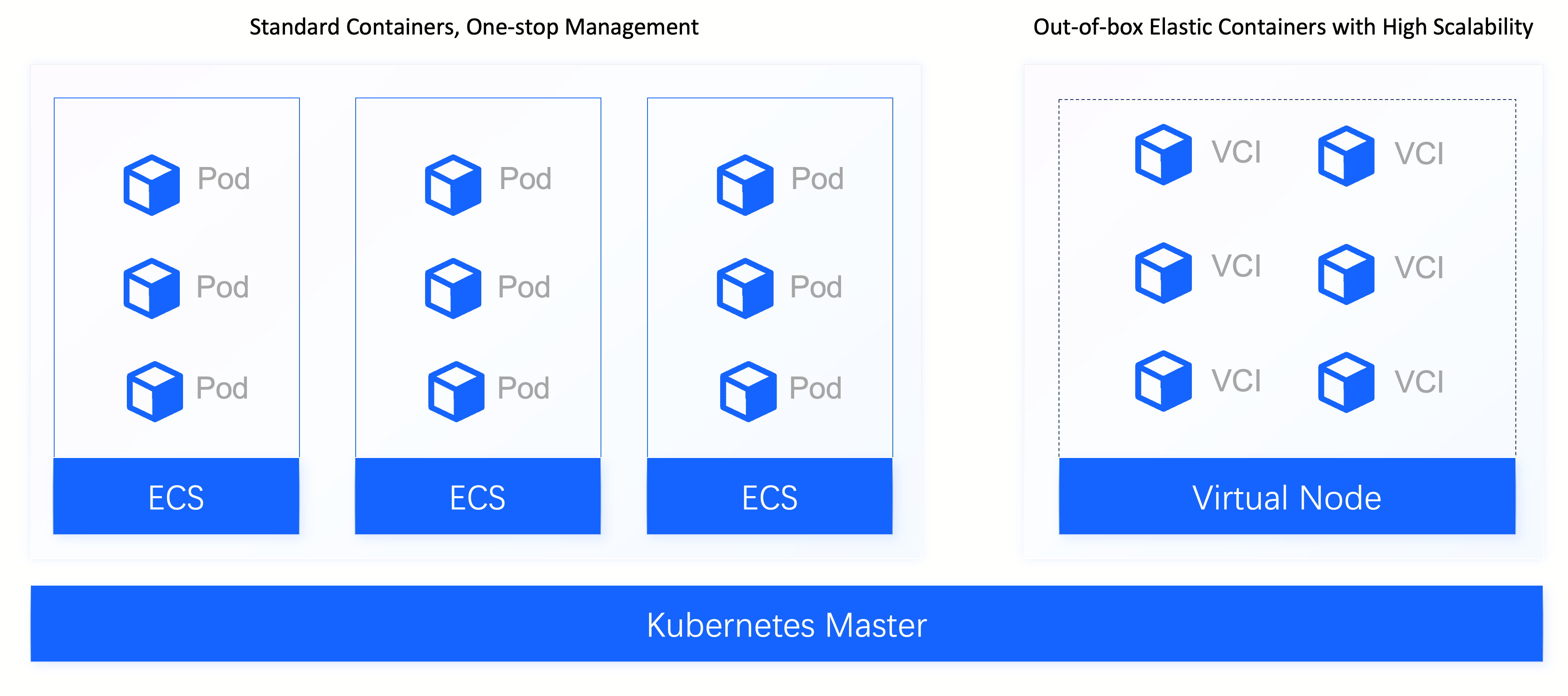
The following table displays the differences between containers of different types and their characteristics.
Container type | Standard container | Elastic container |
Container type | Standard container | Elastic container |
Infrastructure | Elastic Compute Service (ECS) | Volcengine Container Instance (VCI) |
Main characteristics |
|
|
Billing method | It uses the pay-as-you-go billing method. You are charged based on the usage of infrastructure resources. | It uses the pay-as-you-go billing method. You are only charged based on resource usage. |
Application scenarios |
|
|
tip
Service architecture
Inference architecture
Model acceleration
PD disaggregation
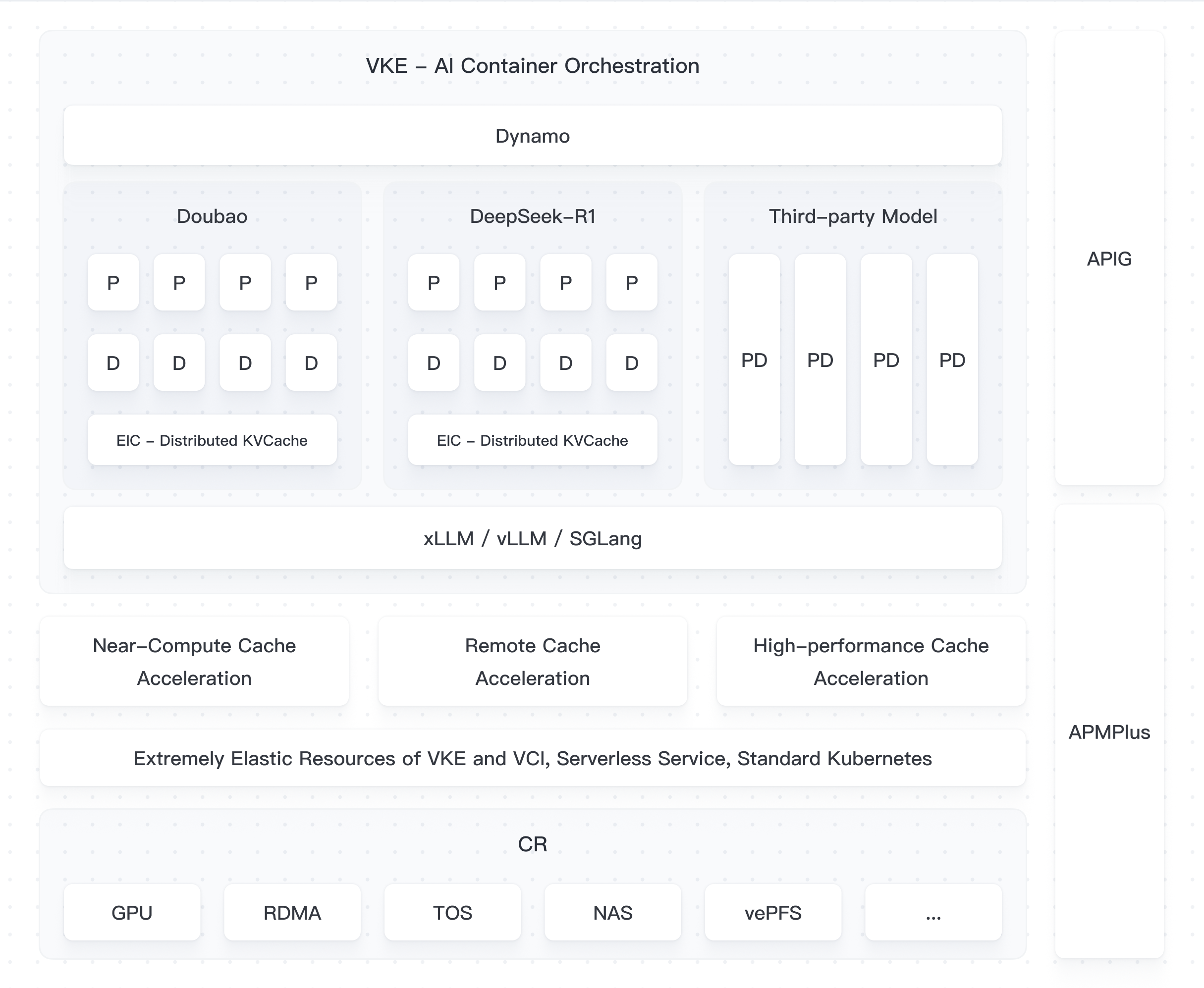
VKE deeply integrates with the new generation of cloud-native AI technologies to provide capabilities such as deployment acceleration, application orchestration, and resource scheduling for AI workloads.
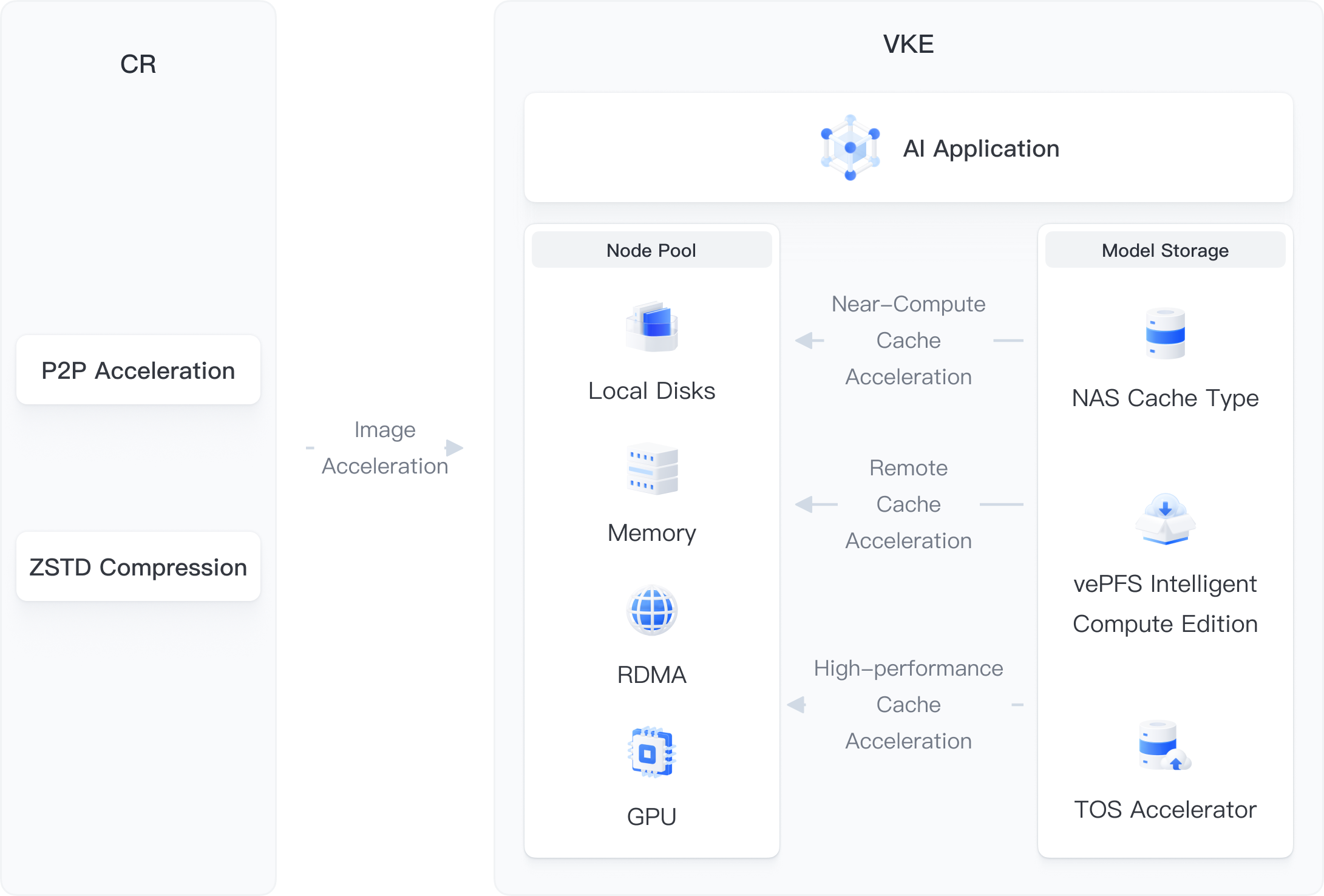
By leveraging the point-to-point (P2P) technology and model loading tools, VKE can deploy the complete DeepSeek-R1-671B model on over one hundred GPUs within minutes, which greatly reduces model deployment duration.
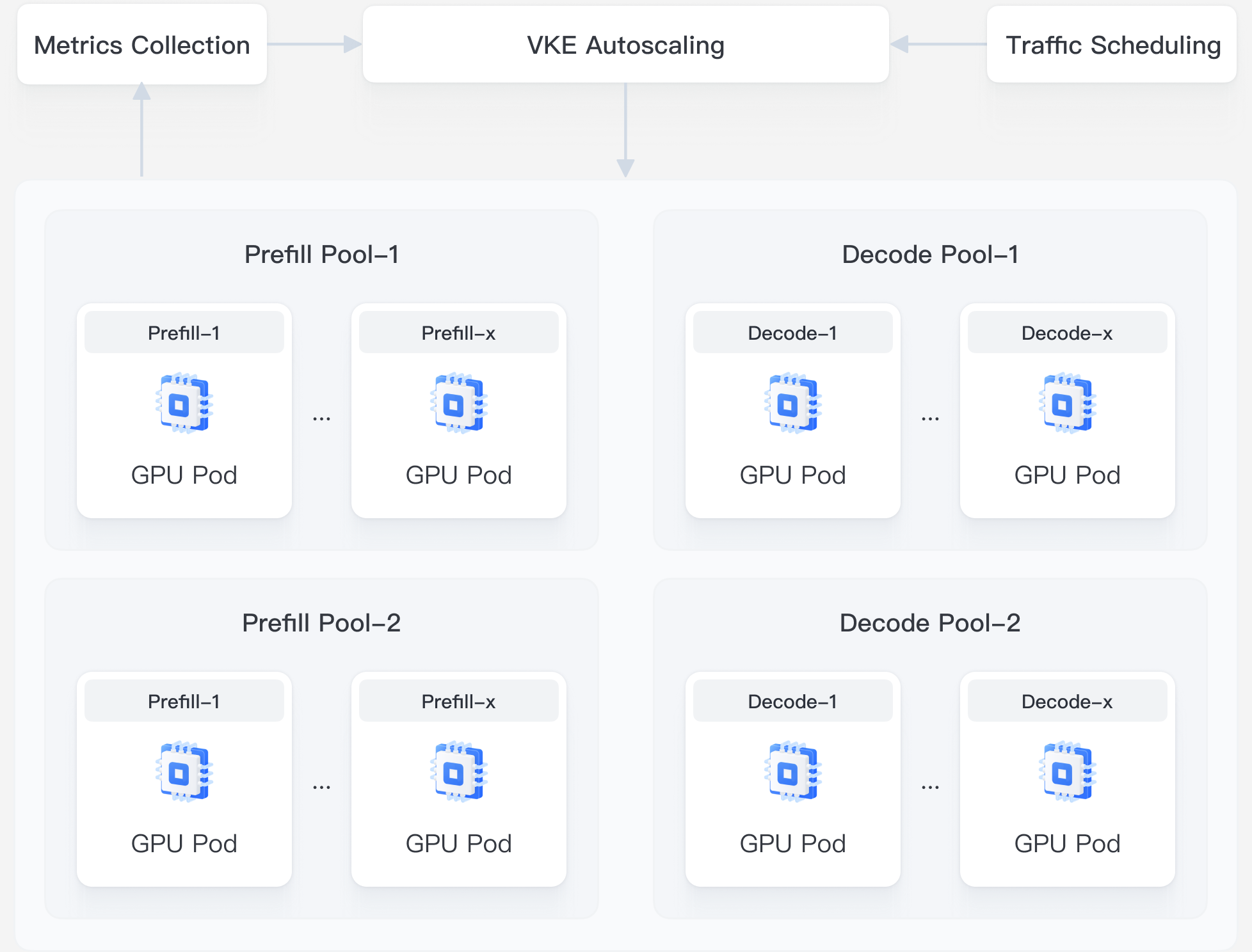
The prefill phase is separated from the decode phase, and prefill instances and decode instances can be dynamically scaled based on composite metrics.
References
- FAQs
Last updated: 2026.04.15 16:29:14
All rights reserved © Beijing Volcano Engine Technology Co., Ltd2024
