Volcengine Kubernetes Engine
Volcengine Kubernetes Engine
Volcengine Kubernetes Engine


Document
Volcengine Kubernetes Engine
What's New
History feature release notes
Kubernetes version release notes
Containerd runtime release notes
Add-on release notes
Monitoring add-ons
Scheduling add-ons
DNS add-ons
Security add-ons
GPU add-ons
Sandbox add-on
Security announcements
Product Announcement
Historical announcements
Overview
Getting started
User guide
Clusters
Creating clusters
Connecting to clusters
Upgrading clusters
Node pool
Creating node pools
Scaling out/in node pools
Nodes
Authorization management
Image
Namespaces
Networking
Cluster network
Container Network
Service
LoadBalancer
CLB
Ingress
APIG Ingress
ALB Ingress
Customize ALB Ingress forwarding rules
Certificate and security
CLB Ingress
Nginx Ingress
Gateway API
Workloads
Creating workloads
Configure workloads
Pods
Configuration management
Image acceleration
Storage
FSX client
EBS Volumes
TOS Volumes
NAS volumes
FSX access methods
NFS access methods
EFS volumes
vePFS volumes
FSX access methods
vePFS Client access methods
NFS access methods
CloudFS volumes
Local volumes
Autoscale
Node autoscaler
Workload autoscaler
Horizontal Pod Autoscaler (HPA)
Cron Horizontal Pod Autoscaler (CronHPA)
Intelligent Horizontal Pod Autoscaler (IHPA)
Horizontal Pod Autoscaler based on event-driven (KEDA)
Add-on management
Network add-ons
Storage add-ons
Monitoring add-ons
Scheduling add-ons
DNS add-ons
GPU add-ons
Core add-ons
Sandbox add-on
Upgrading add-ons
Heterogeneous computing
NVIDIA GPU
mGPU scheduling
RDMA high-performance computing
Scheduling management
Topology-aware scheduling
QoS-aware scheduling
Observability
Log management
Basic observation
Setup & Configuration
Cluster observation
Storage observation
Other observation
Using metrics
Full stack observation
Alert management
Diagnosis and inspection
Node check and self-healing
Application center
Backup center
Stability
Large-scale cluster management
Best practices
Authorization
Clusters
Nodes and node pools
Networking
Storage
Scheduling
Observability
Solution
Security and compliance
API reference
Cluster management
NodePool management
Node management
Virtual nodes management
Add-on management
Tag management
Access policy management
Instance images management
Cloud native observability
Inspection and diagnosis
Task management
Volcengine Container Instance
Appendix
SDK reference
Development guide
Terraform
FAQs
General FAQs
Cluster FAQ
cluster management
cluster network
cluster upgrade
Node and Node pool FAQs
Authorization FAQs
Workload FAQs
Service and Ingress FAQs
Storage FAQs
Heterogeneous computing FAQs
Observability FAQs
Quota FAQs
Add-on FAQs
Cloud-native AI
ServingKit
LLM applications
ComfyUI application
Deploying the Al inference application through Helm
Deepseek practices
Qwen practices
Kimi practice
Seed practices
Best practices
DeepSeek model deployment
GLM model deployment
MiniMax model deployment
Qwen model deployment
Kimi model deployment
Volcengine Container Instance
What's new
Historical feature release notes
Product Announcement
Overview
Billing
User guide
Integrating with VCI
Virtual node
VKE cluster uses virtual nodes
Self-managed/third-party cluster uses virtual node
Creating an instance
General purpose instance
GPU-accelerated computing instance
VCI Agent Sandbox
Startup acceleration
E2B-based management
Upgrade guide
Networking
Monitoring
Scheduling
Container configuration
VCI Image Cache
Best practices
Security and compliance
FAQs
- Documentation
 Volcengine Kubernetes EngineVolcengine Container InstanceOverviewProduct advantages
 Copy page
 Download PDF
Overview
Product advantages
Copy pageDownload PDFProduct advantages
VCI provides advantages like extreme elasticity, high performance, zero operations and maintenance (O&M), and ease of use. It helps you quickly build and deploy containerized applications and ultimately enhances business efficiency and quality. This topic describes the advantages of VCI.
Zero O&M
- VCI uses fully managed serverless architecture, which saves you from node O&M efforts.
- You need to submit container images, without worrying about the underlying servers or capacity planning. You can focus on business innovation.
Ultra scalability
Fast scaling
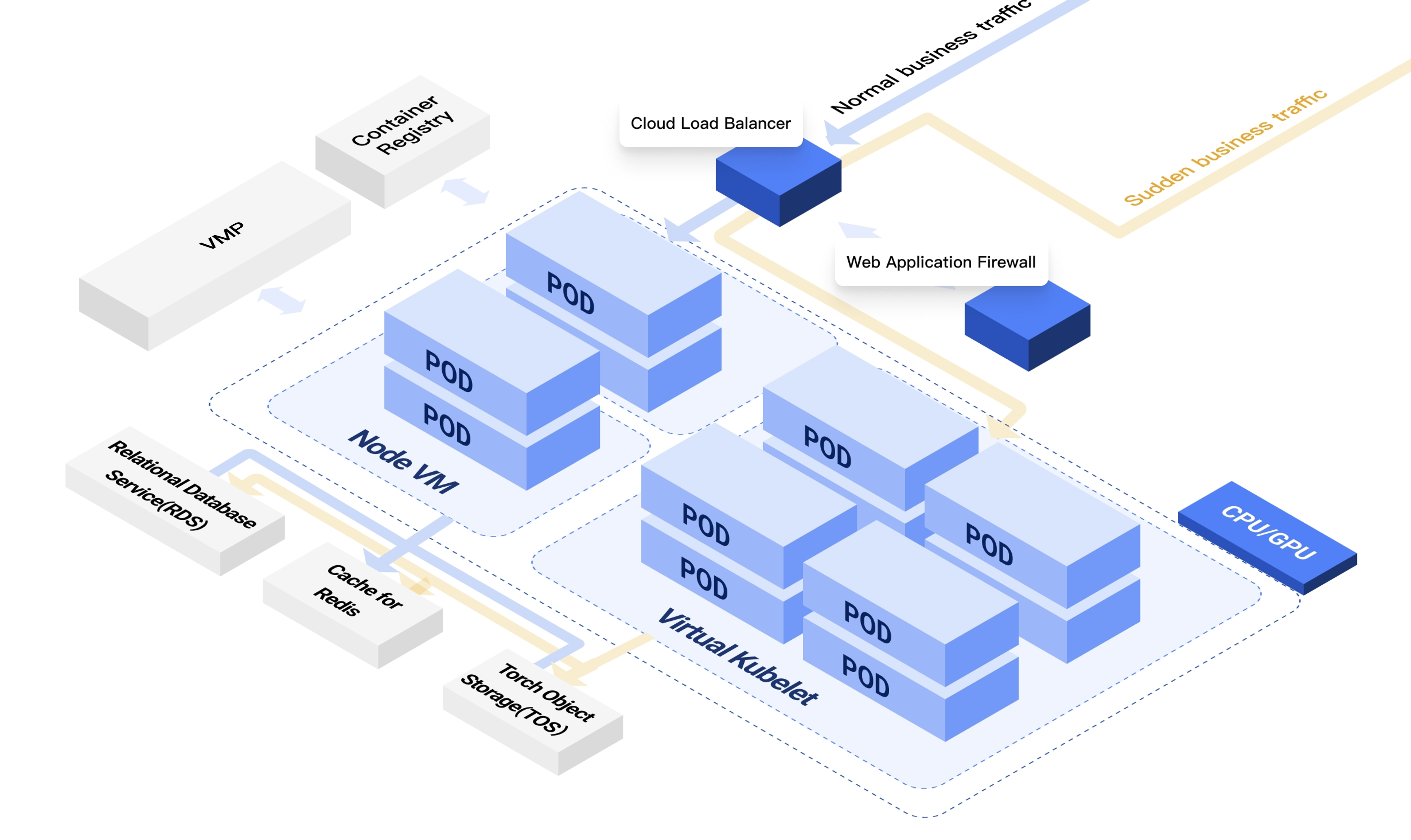
VCI supports autoscaling and load balancing. This support allows you to automatically expand or shrink the scale of VCI instances based on business needs to handle peak and off-peak traffic. The system also automatically distributes business traffic across different VCI instances via load balancing to improve application performance and availability:
- This efficient scaling can meet the demand for tens of thousands of vCPU cores within minutes and ensures that sufficient computing resources are quickly provisioned when business needs arise.
- It leverages various container image acceleration capabilities provided by Volcengine Kubernetes Engine (VKE), such as lazy loading of images and P2P-based image distribution. Additionally, it features unique acceleration mechanisms like image caching. These capabilities ensure that the overall startup time for a pod (with image data up to hundreds of GiB) can be controlled to within ten seconds, significantly improving user efficiency and reducing cloud costs.
Adequate scaling
- VCI fully integrates computing resource infrastructure of Volcano Engine to supply computing power, and offers multiple instance families based on different underlying hardware capabilities. These families deliver differentiated computing, storage, and network performance to support a wide range of business applications and scenarios:
- The general-purpose CPU instance families provide balanced vCPU, memory, and network capabilities to meet service requirements in most scenarios.
- The GPU-accelerated families deliver cost-effective performance for various AI computing scenarios such as large model training, text and image generation, and task inference.
- Based on sufficient computing resource supply, VCI provides elastic resource priority scheduling strategies. Together with VKE, it supports flexibly scheduling pods to different types of computing resource pools (such as ECS and VCI) via custom resource policies (ResourcePolicy). Scheduling and allocation are performed based on actual business scenarios by using strategies like percentage thresholds and priority control.
Cost-effective scaling
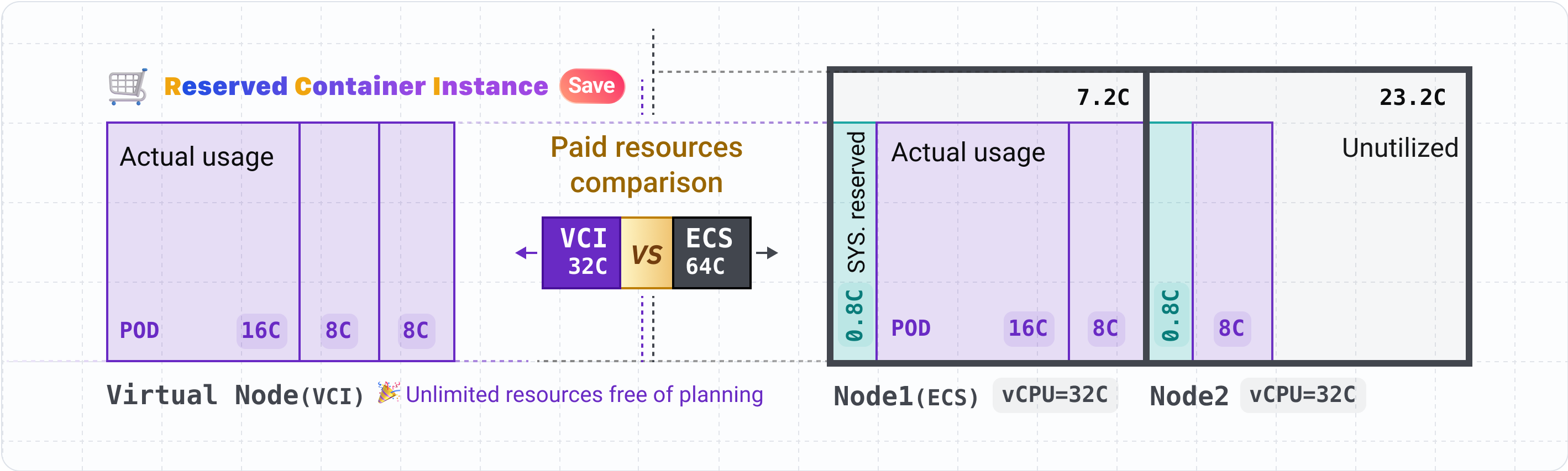
Deploying containerized businesses with VCI reduces overall business costs, as you only pay for the resources actually used:
- Billing is based on the resources actually consumed by pods, such as vCPU, memory, and GPU. The billing duration for VCI instances equals their uptime, which spans from the start of container image download to the stop of pods, with precision down to the second.
- VCI reduces idle resources and improves bin packing efficiency, thereby lowering your computing resource costs.
Efficient isolation
Based on MicroVM technology, it provides VM-level isolation, which contributes to lower resource consumption and higher efficiency. VCI supports small-specification, fine-grained (small-step) allocation of CPU and GPU resources.
- Built on secure sandbox containers, VCI provides VM-level security and resource isolation. Each instance runs in a dedicated kernel and does not share infrastructure resources with other workloads or pods.
- VCI is deeply optimized for container runtime environments and offers faster startup speeds and higher operational efficiency than traditional VMs.
Advantages compared with regular container instances
VCI demonstrates outstanding advantages in performance and resource isolation compared with regular container instances.
Feature for comparison | VCI | Regular container instance |
Feature for comparison | VCI | Regular container instance |
Kernel | Dedicated kernel. | Shared kernel. |
Isolation | Hard isolation based on virtualization. | Soft isolation based on namespaces and Cgroups. |
Scaling | Second-level autoscaling. | Minute-level autoscaling. |
Last updated: 2026.07.24 16:18:02
All rights reserved © Beijing Volcano Engine Technology Co., Ltd2024
